Your Salad's Missing Color: Why Amaranth Microgreens Belong on Every Plate
Amaranth microgreens bring unmatched red-violet color and the highest carotenoid levels of any microgreen. Learn what they taste like and how to grow them.

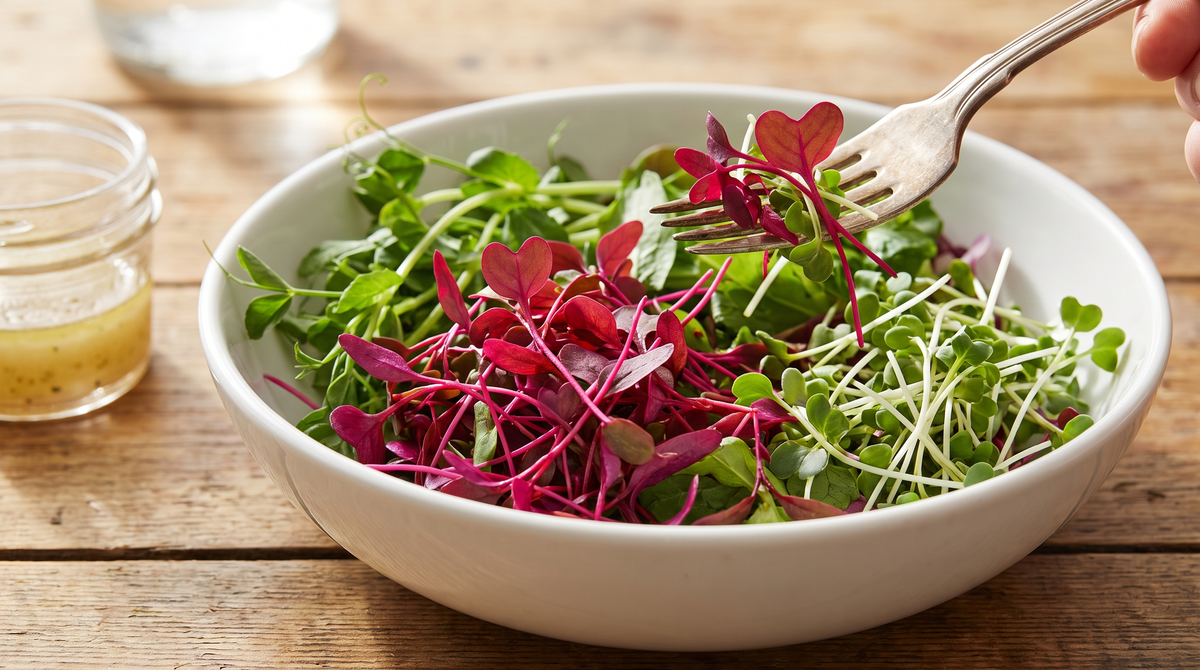
Most people who grow microgreens start with the easy ones. Peas, radishes, maybe some broccoli. They're reliable, they taste good, and they sell. But there's one that keeps getting overlooked, and it shouldn't.
Amaranth microgreens are the most colorful thing you can put on a plate. Not just pretty. The kind of color that makes people stop and ask what it is.
What Are Amaranth Microgreens?
Amaranth microgreens come from Amaranthus tricolour L., the same plant family that gives us red beet and chard. Researchers have been studying them for years, and the numbers tell a story most growers haven't heard yet.
That deep red-violet color isn't from anthocyanins, the pigments you find in blueberries and purple kale. Amaranth uses betalains instead. Specifically, a compound called amaranthin makes up nearly three-quarters of the pigment load, at 73.56 percent of total betalains detected. Betalains and anthocyanins are mutually exclusive in plants. You get one or the other, never both. Amaranth went the betalain route, and the result is a red that leans toward magenta, with green undertones from chlorophyll.
And there's a lot of chlorophyll. In a 2020 study comparing multiple microgreen species, amaranth tested higher for total chlorophyll than any other, at 638.5 micrograms per gram fresh weight. It also topped the charts for total carotenoids, at 4,073.5 micrograms per gram. That combination of betalains, chlorophyll, and carotenoids in one small plant is unusual. Most colorful microgreens are strong in one pigment family and weak in the others. Amaranth brings all three.
What They Taste Like
Here's where it gets honest. Amaranth microgreens don't win on flavor alone.
A trained sensory panel described the taste as earthy with a slight astringency. Not sweet. Not bright. More like a mild, grounded green with a dry finish. Researchers have noted astringency, bitterness, and sourness as part of the broader sensory profile.
But here's the interesting part. When those same researchers cold-pressed juice from amaranth, broccoli, and red beet microgreens and put all three in front of evaluators, amaranth came out on top for overall acceptability. Not because of taste. Because of how it looked. The color was so striking that people rated it higher despite the flavor drawbacks. Amaranth juice also scored highest for texture, at 4.7 out of 5, thanks to its clear appearance.
That tells you how to use them. Amaranth microgreens work best as a visual garnish. Scatter them over a finished dish where the color does the heavy lifting and the flavor plays a supporting role. They pair well with creamy or mild ingredients that balance the earthy notes. Think ricotta toast, avocado salad, or a white bean soup where that flash of magenta breaks up the beige.
What's Actually in Them
The nutritional picture is mixed, and that's worth being straight about.
On the strong side: amaranth microgreens are loaded with carotenoids. They had the highest lutein levels of any microgreen tested, at 1,478.9 micrograms per gram. Their provitamin A carotenes came in second only to kale, at 1,769.2 micrograms per gram. Zeaxanthin measured 132.2 micrograms per gram, also near the top of the comparison set. The ash content, a rough proxy for mineral density, was 1.6 percent. That's the highest among all microgreens in the study.
Phenolic compounds are present in meaningful amounts, though researchers report a wide range depending on extraction method and cultivar. One study found 646 mg per 100 grams fresh weight. Another found 133. Both are credible. The difference comes down to lab methods and growing conditions. What's consistent across studies is that phenolic acids dominate the profile, with feruloyl isocitric acid as the standout compound at 175.78 mg per 100 grams. A quercetin glycoside, the only flavonoid detected in amaranth, came in at 24.37 mg per 100 grams. Quercetin is a compound studied by researchers for its health-supporting properties.
On the weaker side: vitamin C is low at 8.9 mg per 100 grams. There are no detectable sugars, which means a low-calorie profile but also no natural sweetness to balance the astringency.
One number deserves a clear note. Oxalic acid measured 120.8 mg per 100 grams fresh weight, the highest among all microgreens tested. Oxalic acid is common in leafy greens. Spinach and chard have it too. But at this level, it's worth knowing that oxalic acid can bind to minerals and reduce how much your body absorbs. This isn't a health warning. It's a compositional fact that matters if you're thinking about amaranth as a daily staple.
Growing Them
Amaranth microgreens are a mid-speed crop. In controlled studies, they were harvested 12 days after germination, when the first true leaves and fully expanded cotyledons had developed. The general microgreen harvest window runs 7 to 21 days, and amaranth sits comfortably in the middle. That puts them in the same turnaround range as broccoli, faster than slow growers like cilantro or dill.
They're grown the same way as other microgreens. Seed densely on a tray, keep humidity high during germination, then move to light. Harvest at the base of the cotyledons when the first true leaves start showing. The shelf life is short. Like all microgreens, they're best eaten within a day or two of cutting. Refrigeration helps, but these aren't a crop you store for the week.
One practical note for anyone thinking about juicing them: amaranth gave the lowest juice yield of three species tested in a cold-press study, at 53.4 percent. Broccoli hit 70.2 percent, red beet 62.0 percent. If you're pressing microgreens for juice, amaranth won't be your volume crop.
Final Thoughts from Wilshires Organics
Amaranth microgreens earn their place on looks alone. The color is unmatched, and the carotenoid numbers back up what your eyes already tell you. They're not the sweetest or the mildest microgreen you'll grow, and they're not a vitamin C powerhouse. But if you want something that makes a plate pop and brings a dense package of pigments and phenolic compounds along with it, amaranth delivers.
Grow a tray. Put it on something white. You'll see what the researchers saw.
Want fresh-cut microgreens this week? We harvest to order in Ocala and have them ready for pickup. See what's available and reserve your tray.