Love Mustard Greens but Not the Heat? Try Mizuna Microgreens
Mizuna microgreens deliver mild mustard flavor without the heat. Fast-growing and affordable. Learn to grow and use this beginner-friendly brassica green.

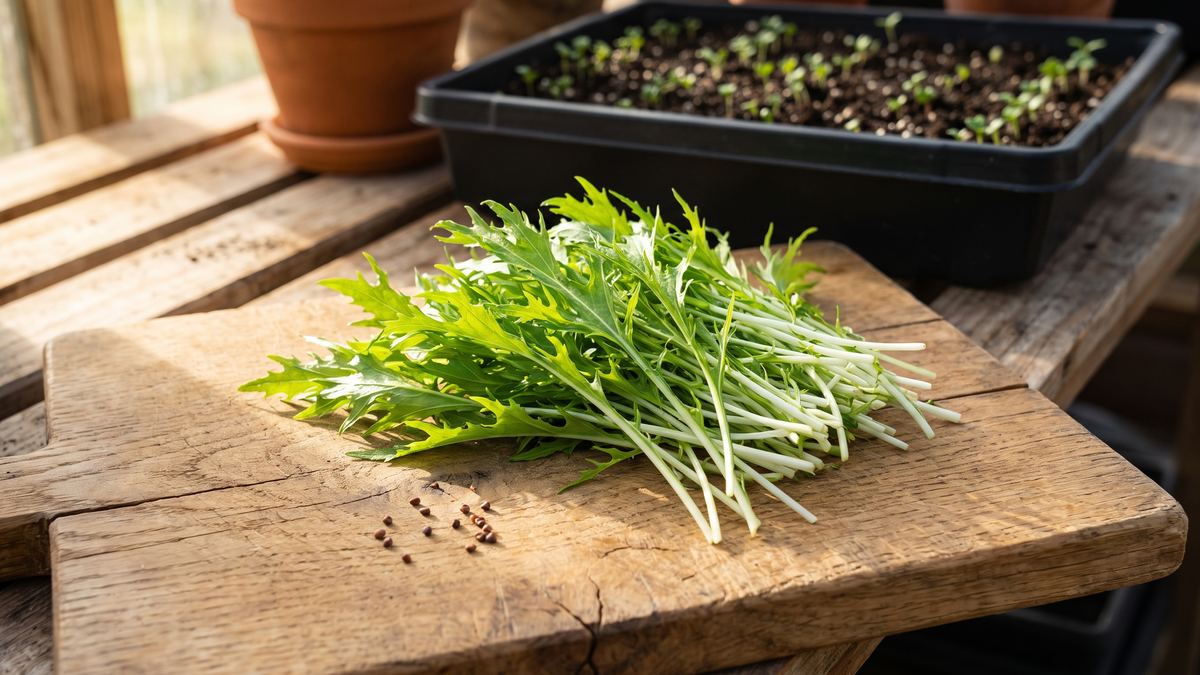
Most people discover microgreens through radish or broccoli. They're fast and forgiving. But if you've ever bitten into a radish microgreen and thought "that's a lot," you're not alone. Some of us want mustard-family complexity without the sinus-clearing punch.
That's where mizuna comes in.
Shirley and I started growing mizuna a few seasons back mostly because we had leftover seed and an empty tray. We didn't expect it to become one of the greens we reach for most. It did anyway.
What Is Mizuna, Anyway?
Mizuna is a brassica, same family as broccoli, kale, and mustard. Its botanical name is Brassica rapa var. nipposinica. The Japanese name means "water greens," and it's been cultivated in Japan for centuries. In 1989 it earned a protected designation as a traditional Kyoto vegetable.
You'll see it called Japanese mustard greens, spider mustard, or kyona. Green varieties like Early and Summer tend milder. Red types like Beni Houshi add slight sweetness and visual punch in a mixed tray.
The Flavor: Mild Mustard, Not Hot
Every seed catalog and extension bulletin that describes mizuna uses one word: mild. Penn State Extension calls it "mild mustardy, peppery." Johnny's says "unique, mild-flavored mustard green." True Leaf Market calls it "very mild mustard flavor that isn't overpowering." High Mowing says "just a hint of spice."
The consensus is clear. Mizuna is noticeably milder than arugula, radish microgreens, or full-strength mustard greens. It gives you the mustard-family character without the heat that makes some people flinch.
Why? Brassica pungency comes from glucosinolates, compounds that break down into sharper-tasting byproducts when you chew. Different brassicas carry different glucosinolate loads. Mizuna sits on the lower end, which is why it lands gentle where mustard lands loud. Direct phytochemical research on mizuna is still thin compared to broccoli and radish, but the flavor evidence is consistent across decades of grower and extension reports.
Growing Mizuna Microgreens at Home
Mizuna is straightforward to grow indoors. No presoak required. Dry seed goes straight onto potting mix, coir, or a hydroponic pad.
Johnny's Selected Seeds ran a 29-variety yield trial in 2017. Their recommended rate: 9.5 grams per 1020 tray, about three flats per ounce of seed. Doubling or tripling the seed didn't increase yield. It only increased disease risk.
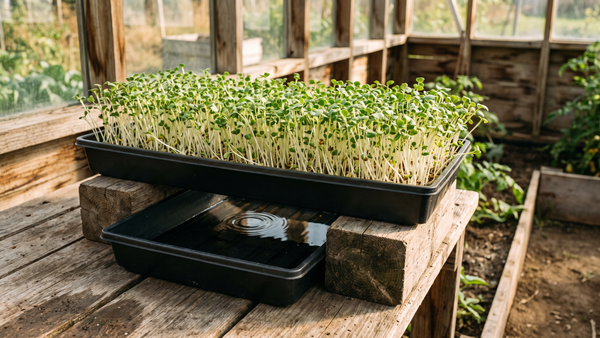
Germination takes 2 to 3 days at room temperature. After a 2 to 4 day blackout, the trays go under light. Harvest comes at 8 to 15 days. Johnny's harvested at 12 days when the first true leaves appeared. Bottom-watering keeps foliage dry and helps avoid damping off.
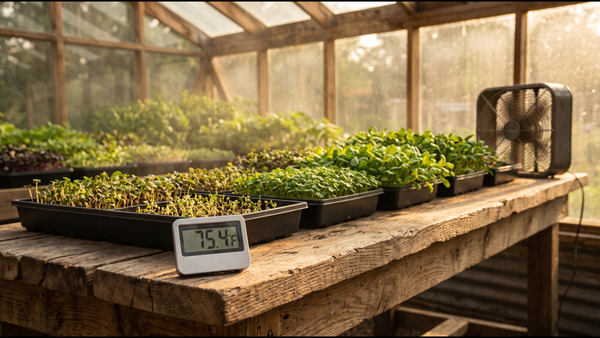
Ambient temperature matters. The sweet spot is 65 to 75 degrees Fahrenheit. Above 75 degrees, disease pressure climbs. Mizuna prefers cooler conditions, which makes it a good indoor crop year-round.
Yield from that 9.5 grams of seed: roughly 10 ounces per tray. Where mizuna really shines is yield per dollar. microgreensguru.com ranks mizuna best value among microgreens: about 25 ounces harvested per dollar. Arugula runs around 21 and broccoli about 14.5.
How to Use Mizuna Microgreens
Mizuna's serrated, feathery true leaves look nothing like radish cotyledons or broccoli's simpler shape. That visual texture stands out in mixed trays.
Penn State Extension recommends it raw in salads, sautéed with onions or garlic, tossed into stir-fries, blended into pesto instead of basil. Both stems and leaves are edible. Johnny's calls it an "excellent addition to any mix."
If your blend runs hot from radish or mustard, mizuna balances the heat without diluting brassica character. Green varieties stay mildest. Red varieties bring a slightly sweet note.
What About Nutrition?
Penn State Extension describes mature mizuna as an excellent source of vitamins A, C, and K-1, plus fiber and minerals. Food tables record mature leaves at about 55 mg vitamin C, 200 mg calcium, and 480 mg potassium per 100 grams raw. Those numbers are for full-grown leaves, not microgreens.
Published research confirms brassica microgreens are substantially more nutrient-dense than their mature counterparts. A 2021 review found them 4 to 6 times more concentrated in key minerals like potassium, calcium, iron, and zinc. They also carry high levels of antioxidants including carotenoids and polyphenols. As a brassica family member, mizuna microgreens contain glucosinolates, compounds studied by researchers for their health-supporting properties. Mizuna-specific microgreen measurements haven't been published yet, but there's no reason to think it diverges from the brassica pattern.
Why Start With Mizuna?
If you're new to growing microgreens, mizuna checks a lot of boxes. Fast. Mild enough that nobody objects. Affordable seed per tray. And those jagged little true leaves beat most grocery-store sprouts for visual appeal.
It's not the fastest brassica (radish beats it by a few days) and it's not the most studied (broccoli owns that title). But for a home grower who wants mustard flavor without mustard heat, it's hard to beat.
Final Thoughts from Wilshires Organics
Mizuna won't replace radish or broccoli as the workhorse microgreens. It doesn't need to. What it does is fill a specific gap: all the mustard-family character with none of the sinus-clearing intensity.
If you've been curious about growing your own microgreens but don't know where to start, mizuna is a forgiving first choice. If you already grow microgreens and want something new in the rotation, it earns its tray space.
Want fresh-cut microgreens this week? We harvest to order in Ocala and have them ready for pickup. See what's available and reserve your tray.