Store Greens Fade in Days: Why Your Microgreens Tray Gets Planted After You Order
See how a harvest-to-order microgreens tray works at Wilshires Organics, from fresh seed and blackout days to a cotyledon-stage cut on pickup week.

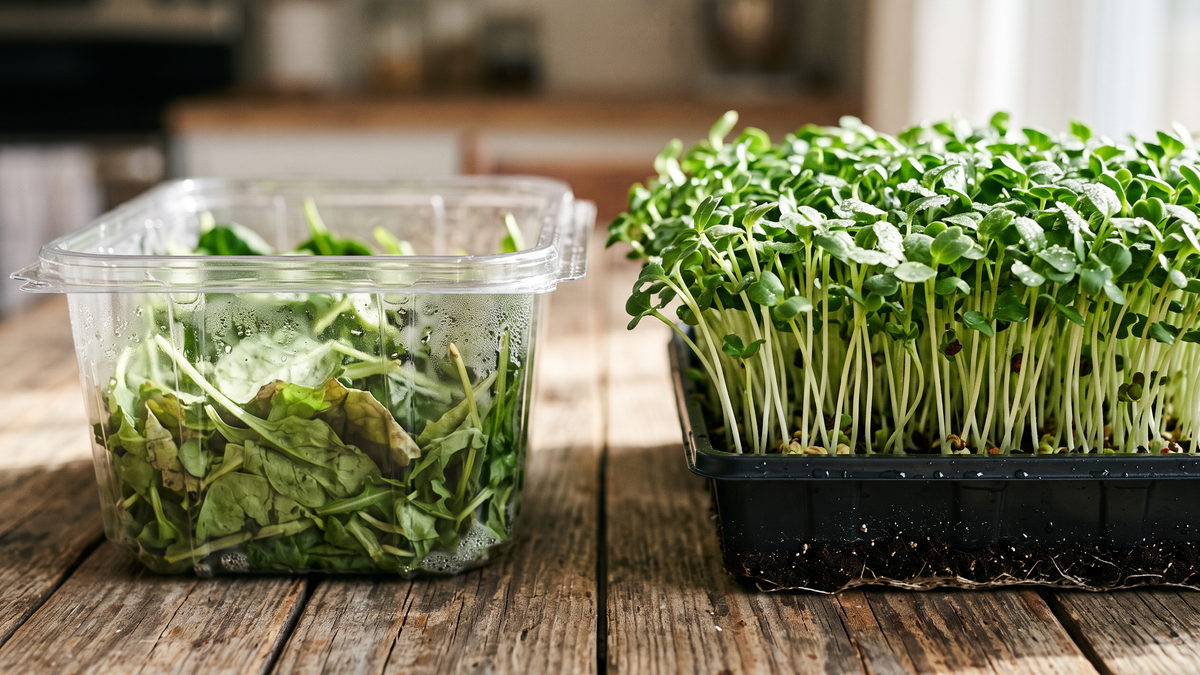
When you order microgreens from a farm that grows to order, your order date starts the clock. The tray gets planted for you after you order, and the wait before pickup is real growing time. Microgreens can take as little as 7 days and up to 21 days from seeding to harvest, depending on the crop and the growing conditions. That range, from Penn State Extension, explains why your pickup doesn't happen the day after you order.
The reason a farm bothers with this model comes down to one problem: microgreens don't hold well after cutting. Their post-harvest life is short, which is exactly why they make sense as a local, order-first crop. The shorter the time between harvest and your kitchen, the better the tray eats.
Why Seed Choice Happens First
Shirley starts with the seed itself, and she's picky about freshness. Old seed, especially seed that sat in a hot warehouse, loses its ability to sprout well. She sources from dedicated seed sellers because freshness matters more than anything else at this stage.
There's a food-safety reason behind that care too. Penn State Extension recommends organic or non-treated seed, because for some crops the seed coat stays on the seedling, and you eat it.
Seeding: Thick, One Type Per Tray
Shirley seeds thickly. That's standard practice for microgreens: the goal is maximum seedlings per tray without stretching or disease, and rates adjust for seed size, germination, and season (lower rates in summer, lower for large seed).
She generally keeps one type per tray. Different crops sprout and grow at different speeds, so mixing types in one tray makes harvest timing impossible to manage. Growers combine types after harvest instead.
Shirley's grow medium is her own: 3 cups Black Kow compost to 1/4 cup peat moss, with the peat there for moisture retention. She'll tell you herself that her methods come from experience and "may not be documented in scholastic journals." That honesty is part of why we share her recipe.
The Blackout Days: A Few Days in the Dark, Checked Daily
After seeding, trays go into blackout: a few days in darkness, just until the tray sprouts, with a daily check. Once seedlings sprout, the cover comes off. That's the whole protocol. No exact day counts, because the tray itself tells you when it's ready, not the calendar.
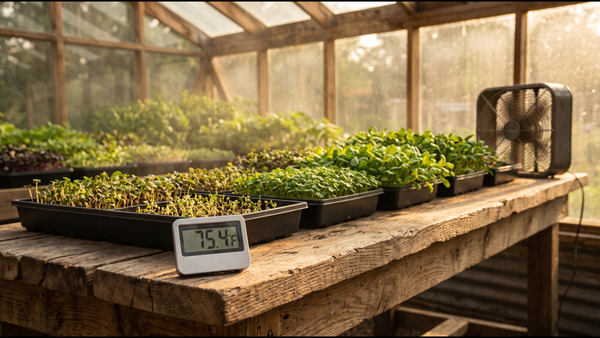
Germination works best in soil at 60-75°F with air around 60-70°F. Within that window, the tray sprouts when it sprouts, and Shirley checks every tray every day.
Light Phase: Low Light, Dry Leaves
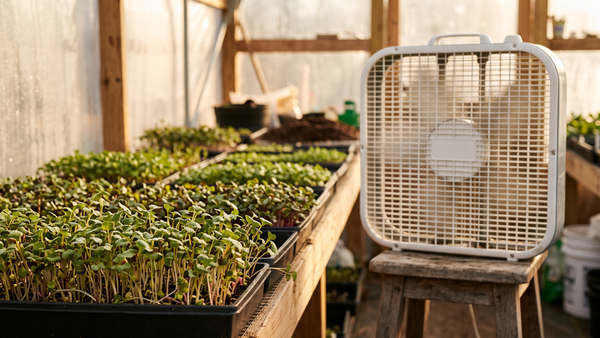
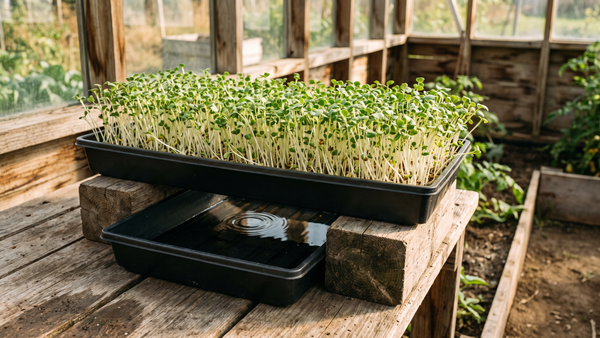
Once trays are under light, the crop stays low-light. Microgreens are a low-light crop, so they don't need a high-light setup to grow well. Dry leaves matter more than intense light: the main disease, damping-off, thrives in warm, humid conditions, so growers water from below. The greens stay dry while the roots drink.
As for feeding: little or no fertilizer is needed, because the seed carries the seedling through its short life. Shirley puts it in her own words: seeds are supposed to have everything the seedling needs, "but that's not always the case in her experience," and nutrients only matter for speed or flavor.
Watching for the Right Moment to Cut
From seeding to harvest, the range is 7 to 21 days. Some crops, like radish and broccoli, tend to be ready in about a week and a half; slow crops like cilantro take longer. Every crop runs on its own schedule, and the tray tells you more than any calendar. The real harvest signal is visual: microgreens are cut at the cotyledon stage, when the first leaves have fully expanded and before true leaves emerge. Height lands around 1.5 to 3 inches.
Why watch daily near the end? Cut past that stage and texture toughens, flavor shifts. That's the kind of thing you learn by watching trays, and it's why the daily check matters most in the final days.
Harvest: Cut Stems, Leave the Roots
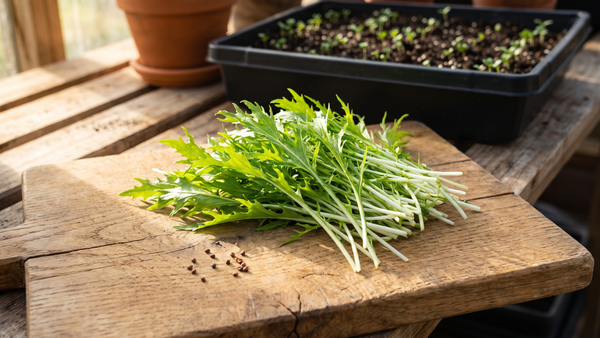
Harvest is straightforward: cut stems, leave roots and media behind, use sharp scissors or a knife. Electric clippers are faster, but they tear stems and shorten post-harvest life, so sharp hand tools win on a small farm.
The tray gets cut close to pickup. Ideally, microgreens go to market immediately after harvest; otherwise, brief cold storage. Researchers have found that cold, dark storage at 41°F can extend shelf life to 10-14 days, versus 2-4 days at ambient temperature.
Pickup: Dry, Cut Close to Pickup, Wash at Home
Pickup day is the whole point. Growers typically harvest dry and tell customers to wash at home, because washing before sale shortens post-harvest life. So don't rinse your tray when it arrives, wash right before you eat.
One more thing worth knowing: microgreens generally have higher concentrations of vitamins than the same plants grown to maturity, and researchers have studied their compounds for health-supporting properties.
Final Thoughts from Wilshires Organics
Microgreens don't ship well or hold long, and that's not a flaw, it's the reason your tray gets planted after you order. Shirley's process, seed freshness, one crop per tray, blackout with daily checks, dry harvest, is built around one idea: the freshest tray on your pickup day. Check the harvest days order page to reserve a tray, or stop by the farm stand on Saturdays and see what's growing.
References
- Penn State Extension, Growing Microgreens
- Mir et al. 2017, Critical Reviews in Food Science and Nutrition (PMID 26857557)
- Riggio et al. 2019, International Journal of Food Microbiology (PMID 30308448)
- Kaya & Yardımcı 2025, PeerJ (PMID 41321944)
Want fresh-cut microgreens this week? We harvest to order in Ocala and have them ready for pickup. See what's available and reserve your tray.