Miss Your Harvest Window? How Greenhouse Temperature Controls Your Microgreen Schedule
Greenhouse temperature controls your microgreen schedule. Learn the 60-75°F target, how warm temps speed harvest but cut yield, and how to adjust sowing.

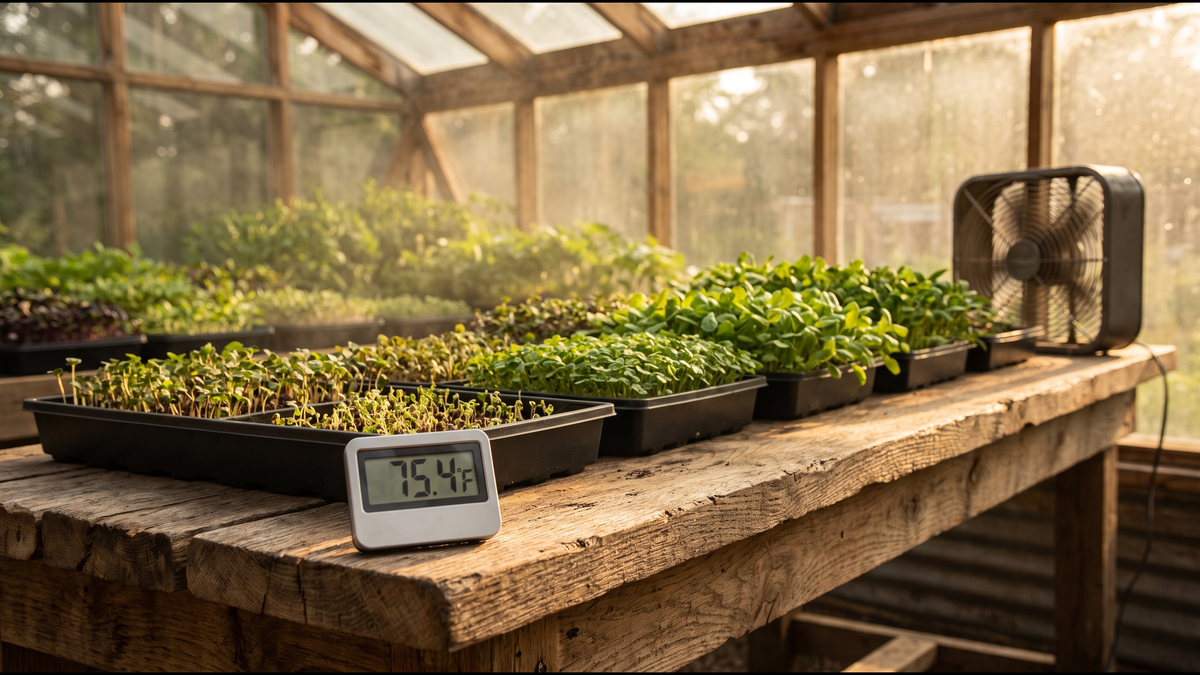
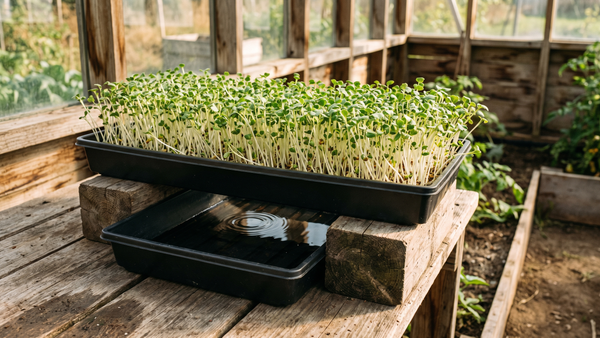
You plant a tray of radish microgreens on Monday. The schedule says harvest Friday. But the greenhouse hit 80°F on Wednesday, and by Thursday those seedlings are past their prime. You missed the window by a full day.
Temperature did that. Not your seeds, not your lighting. Temperature is one of the most important environmental variables in microgreen production. Penn State Extension calls it "a primary driver of production speed." If you grow in a greenhouse, understanding how temperature shifts your schedule is the difference between consistent harvests and trays you can't sell.
The Target Range: 60 to 75 Degrees
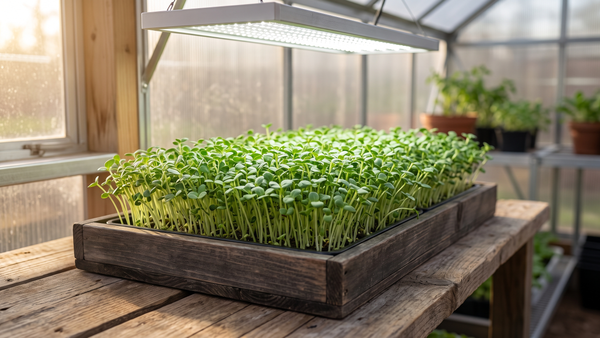
Multiple extension sources converge on the same range: 60 to 75°F for microgreen production. Penn State lists ideal soil temperatures at 60 to 75°F and ideal air temperatures at 60 to 70°F. Utah State gives a day-night split: 74°F during germination, 72°F with lights on, 68°F with lights off.
That's the target, not a hard requirement. Penn State notes that microgreens will grow under less-than-ideal conditions because they only need a short growing period. Viable production happens at 65 to 75°F, even up to 80°F with adjustments.
What Warmer Temperatures Actually Do
Here's the finding that matters most for scheduling. Allred and Mattson (2018), cited in two peer-reviewed reviews, found that raising production temperature from 14°C to 22°C (57°F to 72°F) does two things at once. It cuts days-to-harvest by 35 to 40%. And it reduces fresh-weight yield by 35 to 40%.
Both. Simultaneously. Warmer temps speed up your harvest. They also shrink your crop.
This is the trade-off every greenhouse grower needs to understand. You get faster turns, but each tray produces less. The 35 to 40% figure applies to that specific range (57 to 72°F). It's not a formula you can extrapolate to every 10°F increase. But within the range where most of us operate, the pattern holds: warmer means faster and lighter.
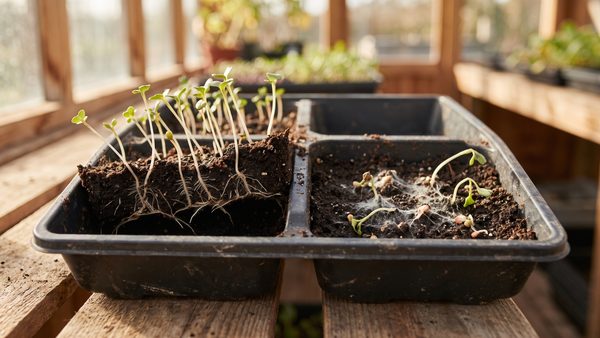
Cold works the opposite way. Below 60°F, germination slows and growth drags. Below 50°F, some growers report needing extended nighttime heating just to maintain growth rates. Cold stretches your crop cycle by days.
Varieties Respond Differently
Fast brassicas handle swings better than most. Radish, broccoli, and arugula mature in 6 to 12 days and tolerate a wider range. Radish is commonly cited as one of the most heat-tolerant species.
Basil is different. Commonly cited guidance puts its ideal range at 72 to 79°F, making it one of the most heat-demanding varieties. Below 68°F, germination becomes irregular. Cilantro is similar: a 21 to 28 day cycle that makes it highly sensitive to temperature swings. Cold snaps delay basil and cilantro the most. Heat waves compress them the most.
These variety-specific ranges come from secondary sources aggregating extension data, not from controlled experiments. Treat them as commonly cited guidance, not verified thresholds. But the pattern lines up with what extension harvest data shows: longer-cycle varieties are harder to schedule when temperatures swing.
Summer Is the Hard Season
If you grow in the southeastern US, summer is your hardest season. Greenhouse temperatures routinely exceed 85°F without active cooling. That's well above the 60 to 75°F optimal range.
Growers in similar climates describe what happens: rapid, uneven growth, weak stems, seedlings sprinting past their harvest window before you can cut them. Warm, damp air with poor airflow invites mold.
These are practical observations from experienced growers, not experimental data. But they're consistent with what the research shows about temperature and growth rate.
The fix? Shade cloth at 30 to 50% density, ventilation, and adjusted sowing frequency. Sow every 3 to 4 days during warm periods instead of every 7. You get faster turns, so you need more trays in the pipeline.
Scheduling Around the Swing
Here's what a temperature-aware schedule looks like. In warm periods, your crop cycle compresses. Radish that takes 10 days at 65°F might finish in 6 to 7 days at 75°F. Sow more frequently to compensate. In cold periods, growth slows. The same radish might take 12 to 14 days. Consider heat mats set at 80 to 85°F for 24 to 72 hours to jump-start germination. LSU AgCenter recommends that range for warm-season crops.
Shoulder seasons, spring and fall, likely offer the most consistent greenhouse temperatures in the southeast. That's a climate inference, not a study result.
Digital thermometers and data-logging sensors help you track what's actually happening. Virginia Cooperative Extension recommends daily monitoring. You can't adjust your sowing cadence if you don't know your temperature.
Post-Harvest Temperature Matters Too
Growing temperature controls your schedule. Storage temperature controls your shelf life. Penn State Extension recommends storing microgreens in the dark at 41°F. Research on mustard microgreens showed they lasted 14 days at 41°F but became unusable after one day at 68 to 77°F.
If you're not cooling your harvest, you're cutting your sellable window from two weeks to two days.
Final Thoughts from Wilshires Organics
Temperature runs your schedule. The more you understand the relationship between greenhouse temperature and your crop cycle, the better you can plan. You don't need perfect climate control. You need to know what your greenhouse is doing, what your varieties need, and when to adjust your sowing cadence. Monitor your temps, pick varieties that match your season, and sow to match how fast things are actually growing.
Want fresh-cut microgreens this week? We harvest to order in Ocala and have them ready for pickup. See what's available and reserve your tray.