Growing Medium Problems? How to Choose a Better Fit for Your Microgreens
Choosing a microgreen growing medium? Compare water, air, salts, crop response, and food-safety factors before deciding.

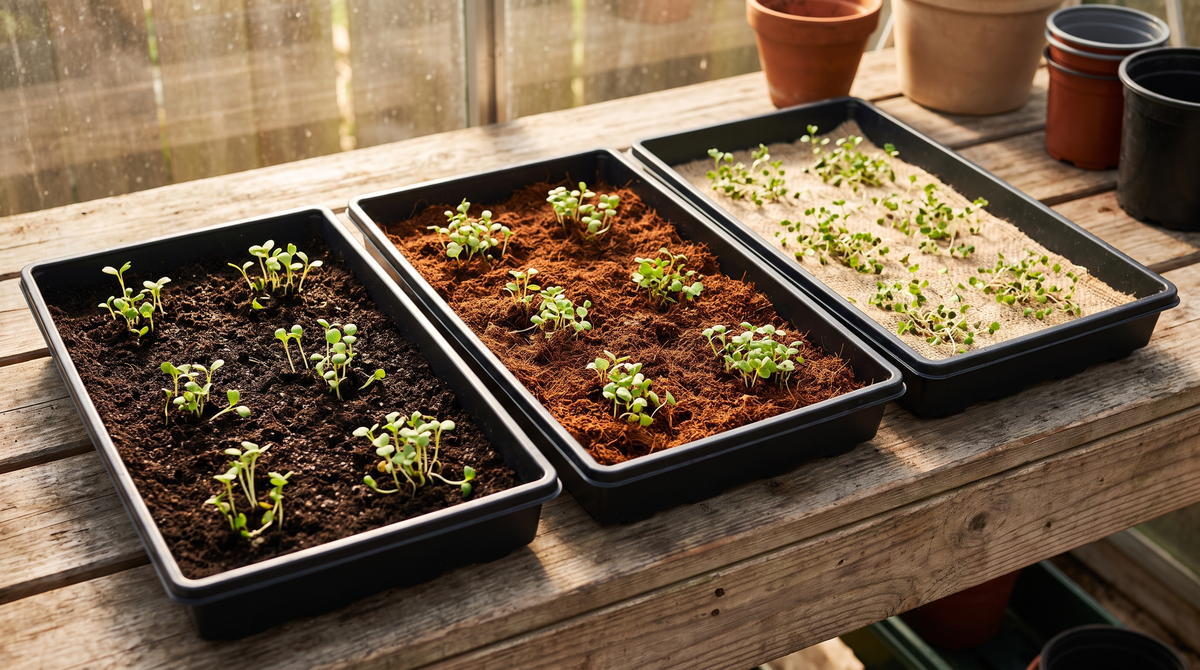
A growing medium has four jobs in container production: hold water, allow air, carry mineral nutrients, and support the plant. For microgreens, the challenge is finding a medium that does those jobs in a shallow tray with your crop and watering system.
Peat mixes, coir, compost blends, fibers, sponges, and mats have been studied. They don't behave the same way, and the research doesn't support one winner. The better question is whether a product fits the crop, tray, irrigation method, and harvest point.
Water holding and air space work together. After a saturated medium drains, some pores retain water while others hold air. A medium that holds more water may need less frequent or lower-volume irrigation. One with more air and less stored water may need smaller, more frequent irrigation. Neither trait should be judged by itself.
Particle size, compaction, and tray depth also change how a medium drains. General container research shows that larger particles tend to favor aeration, while fine particles create more small pores and can raise the risk of excess retained water. A shallow microgreen tray won't behave exactly like a deeper nursery container, so ingredient names alone don't tell you enough.
Product labels can hide meaningful differences. Peat varies with decomposition, particle size, compaction, and handling. Coir can vary with source and processing. Compost varies with feedstock and maturity.
Compare Options Within the Study Boundaries
Two bags with the same main ingredient may not manage water, air, or salts the same way.
Controlled studies show why crop and context matter. In one greenhouse experiment, peat-perlite produced the highest fresh yield for pea, while a 50:50 peat-perlite and organic-waste-compost blend led radish. In a separate climate-chamber experiment, peat produced the highest fresh yield for kohlrabi, pak choi, and coriander, though several other results still depended on both species and substrate.
Those findings aren't a formula for every tray. The experiments used different crops, products, environments, irrigation systems, and harvest endpoints. They do show that a medium leading one comparison may not lead another.
Coir, compost blends, and mats need the same careful reading. One tested coconut-fiber product had relatively high electrical conductivity, or EC, and chloride, with a stronger negative effect on coriander than on kohlrabi or pak choi. That was a product-specific result, not proof that all coir has high salts.
In another experiment, one pure spent mushroom compost measured 23.50 mS/cm EC using a saturated-media extract and produced poor germination in pea and radish. The authors considered that material unsuitable by itself under their conditions. That result doesn't apply to every compost, but it shows why the exact product and measurement method matter.
Check Chemistry and Food Safety
The same caution applies to pH and EC guidance. One paper cited pH 5.5 to 6.5 and EC below 0.5 mS/cm as literature benchmarks, yet successful treatments in that study fell outside those values. Another study used a different extraction method. These figures aren't universal targets, and EC results from different methods aren't directly interchangeable.
A medium's name doesn't establish its safety. In a controlled challenge study, researchers deliberately inoculated nutrient-solution-soaked perlite with Salmonella, Shiga toxin-producing E. coli O157:H7, and Listeria monocytogenes. Transfer occurred from that deliberately contaminated substrate to edible portions of 20 microgreen types under the test conditions. The study showed that transfer is possible in an inoculated challenge. It didn't measure how often commercial media are contaminated.
A separate rapini experiment found medium-associated differences in microbial counts among four tested materials. That supports product-specific evaluation. It doesn't support calling loose media dirty or mats sterile.
Food-safety requirements also depend on the operation and material. FDA guidance distinguishes microgreens from sprouts and explains that some soil- or substrate-grown products fall outside sprout-specific Subpart M while remaining subject to other applicable Produce Safety Rule provisions. When biological soil amendments of animal origin are involved, applicable requirements need to be checked for the farm and product.
Final Thoughts from Wilshires Organics
Don't choose a growing medium from the ingredient name alone. Look at how the specific product holds water, drains, retains air, handles soluble salts, and performs with the crop you're growing.
If you're comparing products, an optional small side-by-side trial can make the decision clearer. Keep the seed lot, tray, seeding density, water, lighting, and harvest rule the same. You could record watering frequency, germination uniformity, harvest timing, usable yield, material carried onto stems, and labor. That's practical reader guidance, not a published testing standard.
The research points to a simple conclusion: medium choice is crop-specific and system-specific. A good choice fits the plant, the tray, and the way water and fertility are managed. Check the evidence behind the product, then judge it under the conditions where it will be used.
Want fresh-cut microgreens this week? We harvest to order in Ocala and have them ready for pickup. See what's available and reserve your tray.