Stop Chasing a Perfect Harvest Day: How to Judge Microgreen Flavor by Crop and Stage
Learn why microgreen harvest timing can affect flavor and how to compare crop stages without relying on one universal peak day.

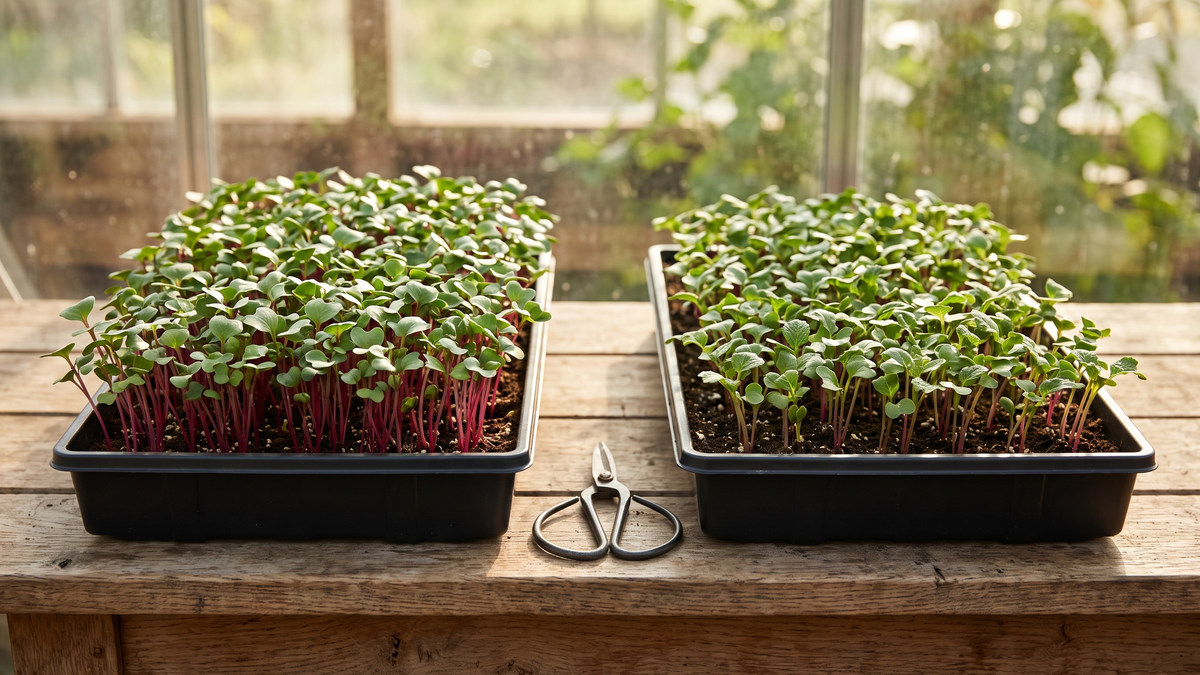
Harvest timing can change flavor-related chemistry in microgreens, but there isn't one peak day that works for every crop. There isn't a dependable rule that younger always means milder or older always means stronger, either. The useful answer is more practical: watch each crop's development, keep growing conditions steady, and compare the same cultivar at nearby stages.
That restraint matters because microgreens develop quickly. Cotyledons open, true leaves begin to appear, and the plant's chemical makeup shifts. The mix of compounds related to aroma, pungency, and bitterness can change during that process. Chemistry measurements aren't consumer taste scores, though. They can't tell us by themselves whether someone will judge a sample as stronger, sweeter, more bitter, or better.
Days after sowing still help with planning. But the date doesn't tell the whole story. According to Penn State Extension, harvest time depends on the crop and its growing environment. Two trays can reach a numbered day without reaching the same developmental stage.
Research gives us useful chemistry and sensory work across different species, but direct taste comparisons of the same cultivar at several nearby harvest stages are scarce. That leaves room for careful crop notes, not a category-wide promise.
Why the Crop Matters as Much as the Clock
Researchers don't use one single developmental cutoff for every microgreen study. Some work uses expanded cotyledons, while other work includes the first or second true leaf. That makes the plant's visible stage a better companion to the calendar than the calendar alone.
A study of komatsuna, mibuna, mizuna, and pak choi compared the first-true-leaf and second-true-leaf stages. Under that study's controlled system, those stages occurred at 7 and 12 days after sowing. Those dates belong to those four genotypes and that protocol. They aren't general harvest instructions.
The Brassica rapa study found that variation in major volatile compounds was greater among genotypes than between the two harvest stages. Individual compounds also moved in different directions as the plants developed. These were instrumental chemistry results, not consumer taste scores, so the findings don't prove that one stage tasted stronger or better.
Cultivar differences show up elsewhere, too. A study of four radish microgreen cultivars found distinct volatile and calculated aroma profiles among them. That study also used instrumental analysis rather than a consumer panel, so its chemistry can't be turned into invented tasting notes. The practical point is simple: variety can matter more than a small timing shift. A radish and a pea shoot shouldn't be expected to follow the same flavor clock, and two cultivars of one crop may not match each other.
Make a Fair Side-by-Side Comparison
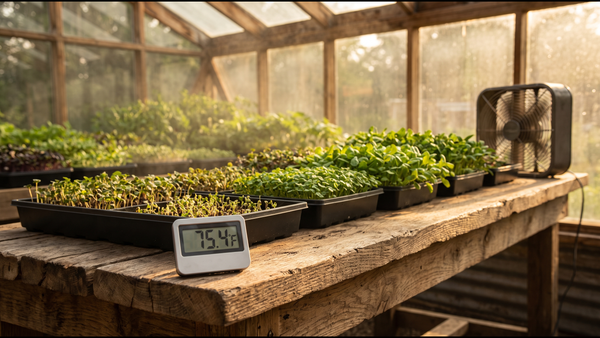
If you want to learn how timing affects one crop, compare the same cultivar under conditions that are as similar as practical. Keep light, temperature, substrate, water and nutrient status, seed density, and harvest method steady. If several of those change between trays, age can't be separated cleanly from the other differences.
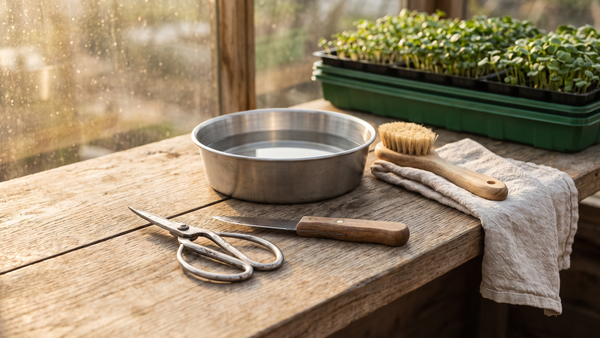
Handling after the cut matters as well. Research on mustard, arugula, and buckwheat microgreens shows that storage temperature, packaging, moisture, and handling can change quality after harvest. Those findings are tied to specific crops and protocols, not universal storage promises. For a useful timing comparison, cut both samples in the same way, taste them after a similar amount of time, and store them under the same conditions.
This doesn't need to become a complicated project. Try a practical farm exercise with two small samples of the same cultivar at nearby stages. Record the sowing date, harvest date, cotyledon condition, true-leaf stage, and any growing-condition exception. Add a short texture note and flavor note, plus the time between cutting and tasting.
That log won't create a universal rule. It can help you make crop-specific observations and repeat the comparison. Over several plantings, the notes may show which stage fits what you're looking for from that cultivar under your setup. Waiting may add size, but more growth doesn't automatically mean better flavor.
Final Thoughts from Wilshires Organics
Harvest timing matters because microgreens are still developing. Yet age is only one part of the decision. Crop, cultivar, growing conditions, developmental stage, and postharvest handling all shape what you're comparing.
Use the calendar as a planning tool, not the final judge. Watch the cotyledons and true leaves. Keep comparisons consistent. Taste the same cultivar at a similar time after cutting, then write down what you observe. Treat the result as a useful note about that crop and planting, not a law for every microgreen. That's a more honest way to find a repeatable harvest window without pretending there's one perfect day for all of them.
Want fresh-cut microgreens this week? We harvest to order in Ocala and have them ready for pickup. See what's available and reserve your tray.