Keep Trouble Off the Next Tray: A Small Grower's Guide to Cleaning Harvest Tools
Harvest tools carry whatever they pick up from tray to tray. Here's the two-step clean-then-sanitize routine we use on our farm.

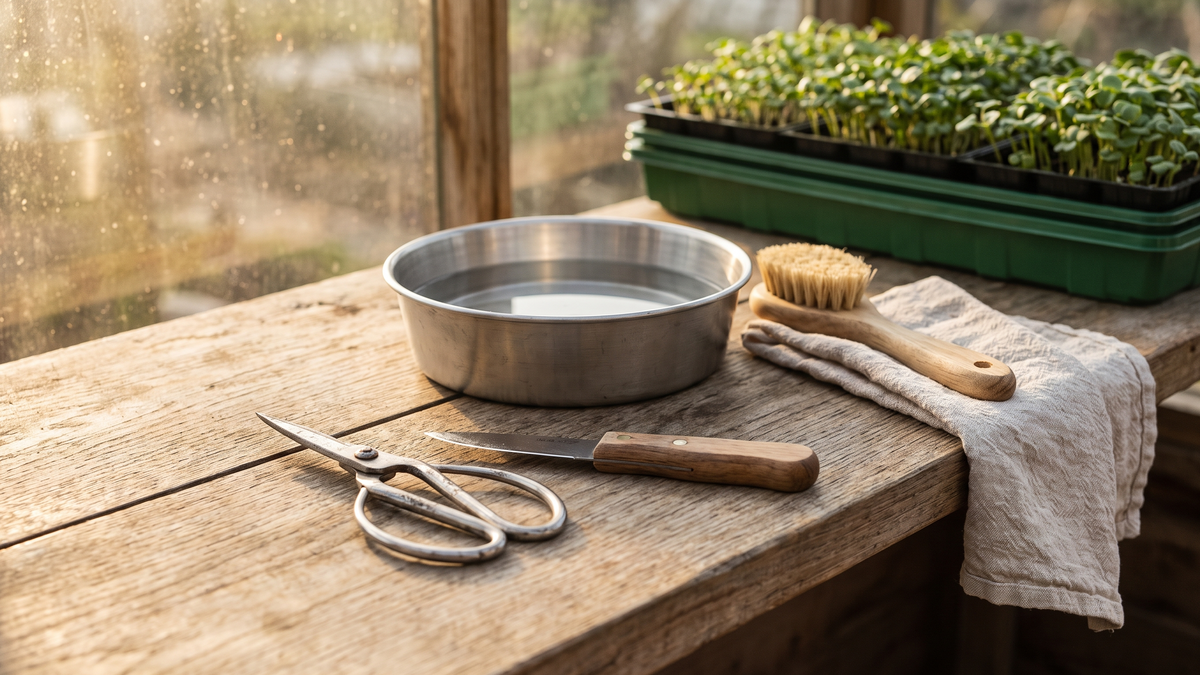
A blade that touches one tray carries whatever it picked up to the next. Scissors, knives, harvest bins, same story. Cut one tray, move to the next, and everything on that tool rides along. That's the argument for cleaning between trays: it keeps one tray's trouble off the rest of the rack.
Why Tool Cleaning Matters Between Trays
Penn State Extension counts harvest tools, bins, and harvesters among the potential sources of contamination during harvest, and says to clean containers and tools between uses so they don't become a source of pathogens that can spread from crop to crop. In their words, there's no good reason for putting clean produce in a dirty container that might introduce a pathogen.
The Michigan On-Farm Produce Safety team, summarizing the microgreens research, adds the blade-level view: hand cutting creates stem openings, and a dirty harvest knife can readily spread bacteria to all the greens it touches.
Our FAQ says it plain: we harvest with clean tools.
Clean First, Then Sanitize
Two steps, in that order. Cleaning lifts dirt and residue off with soap and water. Sanitizing lowers the germs on a surface to a level that public health standards judge safe. The second step needs the first, because sanitizers are not as effective on dirty surfaces. Virginia Cooperative Extension and UGA give the sequence as rinse, clean, rinse, sanitize. Penn State Extension says it shorter: you can't sanitize dirt.
Dish soap does real work. Its surfactants loosen the bond between soil and blade, so sap and grit come off.
What to Sanitize With
Penn State names chlorine solutions and peroxyacetic acid as food-contact options. Everything else defers to the label on your jug.
For a plain bleach mix: one tablespoon of unscented household bleach per gallon of water, with a two-minute contact time or an air-dry. That's the mix Virginia Cooperative Extension and UGA give for food-contact surfaces. It's the same strength we've already written about for greenhouse scrub-downs. Shirley runs that routine every two weeks. Contact times of one to five minutes are usually enough, depending on concentration and how dirty the surface is.
Bleach rules: unscented only, never vinegar or anything acidic, no chlorine on rust-prone tools. Mix fresh at least daily and check strength with test strips.
Alcohol wipes live in our kit as a convenience, handy in a pinch. They evaporate fast and they're flammable, and the documented food-contact route is a labeled sanitizer.
This piece covers tools and containers, not washing the crop. Penn State doesn't recommend post-harvest washing for microgreens unless it's necessary.
Why the Cleaning Step Comes First
Chlorine has a known weakness. It loses its effectiveness quickly in the presence of oil, dirt, and organic material, as Oklahoma State's food process engineers put it. Sap and hulls on a blade tie up the chlorine first. The wash-and-rinse isn't prep for the sanitizer step. It's most of the job.
How Often: Our Between-Tray Routine
Virginia Cooperative Extension says clean and sanitize food-contact surfaces at least at the beginning and end of the day. Penn State's GAPs guidance says clean containers before each use. Between those anchors, here's what we do. It's our routine, built on extension principles, not a rule anyone handed down. Full clean-and-sanitize at the start and end of every harvest session. Rinse-and-wipe between trays when we switch varieties or after a blade touches anything questionable. Full clean anytime anything looks off.
The kit fits one shelf: a brush, dish soap, rinse water, sanitizer in a dip bucket at label strength, test strips, and a clean spot for air-drying.
Where FSMA Fits for a Small Farm
Under the Produce Safety Rule, covered farms must inspect, maintain, clean, and when necessary sanitize food-contact surfaces of equipment and tools, and the rule's own examples include knives and harvest containers. The rule applies to covered farms, and many small direct-market farms fall outside full coverage under the exemption tiers. Worth checking where your own farm falls, or asking your extension office.
We keep a one-line log: date, tool, method, initials. The rule's record requirement applies to covered farms. Ours is a habit we've found useful.
Storing Clean Tools
Clean tools stay clean only if you store them that way. Penn State says to store harvest containers indoors, off the floor, in a clean dry place. Our tool version: a hook or shelf away from splash, where tools hang dry until the next session.
Plastic beats wood for containers because plastic washes and sanitizes between uses. A bin that can't be cleaned or repaired gets thrown out, not patched along.
Final Thoughts from Wilshires Organics
The whole method fits one line: wash it, rinse it, hit it with a sanitizer at label strength, let it dry.
Clean before you sanitize. Follow the label on your jug. Mix fresh and check with test strips. Store tools clean and dry, off the floor. When in doubt, clean it again.
Between-tray cleaning is insurance for the next tray, and the next tray is the one you're counting on. The farm stand's open Saturdays, and the harvest days page takes orders. Either way, your greens get cut with clean tools.
Want fresh-cut microgreens this week? We harvest to order in Ocala and have them ready for pickup. See what's available and reserve your tray.