Stop Losing Trays: How to Store Microgreens So They Stay Fresh Longer
Microgreens can last 14 days or spoil in 24 hours. Here's the research on temperature, moisture, and containers that keeps your harvest fresh longer.

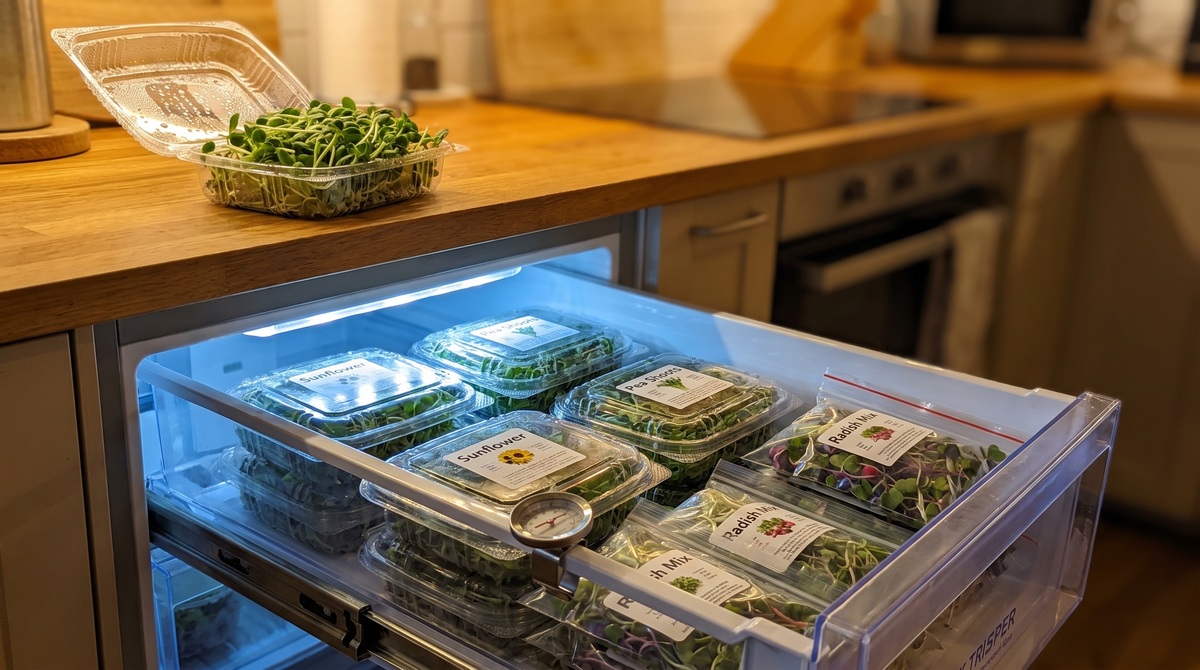
Here's something most microgreens buyers don't realize: the freshest tray you've grown can turn limp and yellow in 24 hours if it hits the wrong temperature. I've watched it happen. A tray of radish microgreens cut at dawn, crisp and standing tall, reduced to a wilted mat by dinner because someone set it on the counter instead of the fridge. That's not a growing problem. It's a storage problem, and it's one of the easiest things to fix once you know the numbers.
The research is clear. A 2023 study on mustard microgreens found that storage temperature alone can swing shelf life from two weeks down to a single day. Getting this right matters whether you're selling at a farm stand or keeping your harvest fresh through the week.
The Temperature That Actually Works
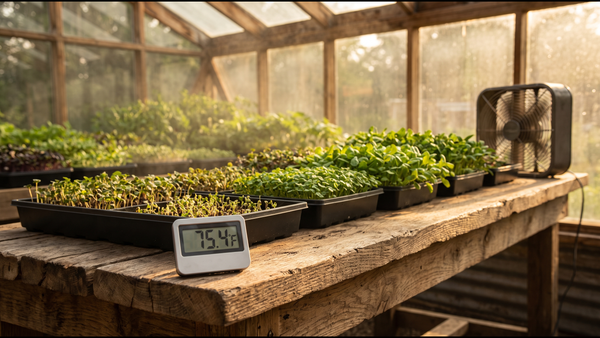
The sweet spot for microgreens is 5 degrees Celsius, which is 41 degrees Fahrenheit. Not colder, not warmer. That number comes from multiple studies across several varieties.
At 5°C, mustard microgreens held their texture and sensory quality for 14 days in sealed polyethylene bags. Drop the temperature to 1°C and you get a marginal improvement. But let it creep up to 10°C and your shelf life collapses: the same mustards that lasted 14 days at 5°C only made it four days at 10°C. At 15°C you're looking at two days. Room temperature wrecks them inside 24 hours.
The takeaway: your target range is 1 to 5°C, and temperature stability matters as much as the number. Small swings from 5°C to 10°C slash shelf life from two weeks to four days. The fridge door is the worst place, the crisper drawer is your friend, designed for higher humidity and steadier temperatures. No study has formally tested fridge zones for microgreens, but the science on what they require points straight to the crisper.
Dry Is the Rule
If you only remember one thing from this article, make it this: store microgreens dry, wash them right before you eat them.
The reasoning isn't complicated. Multiple studies confirm that microgreens need high humidity to stay crisp, but free water pooling on the leaves accelerates decay. Every paper in this space warns about the moisture problem. Microgreens dehydrate fast after harvest, so you need sealed packaging that traps humidity. But wash them and pack them wet, and you've just introduced the very thing that feeds spoilage.
No study has done a head-to-head comparison of "wash before storage" versus "wash before eating" as a standalone experiment. But the consistent finding across the literature, moisture shortens shelf life, makes the direction plain enough. Store dry. Wash at the table.
Packaging matters too. The best results in research come from bags that balance gas exchange while holding moisture in. For home growers, a sealed container or resealable bag with a dry paper towel at the bottom works as a practical stand-in. The towel catches condensation before it pools against the leaves. Nobody's published a peer-reviewed study testing paper towels with microgreens specifically. But the principle is sound and the risk is zero.
One more thing: store microgreens in the dark. A USDA study on radish microgreens found that light exposure during storage accelerated deterioration. Dark storage kept the carotenoids intact and preserved antioxidant capacity better. The only thing light improved was vitamin C content, and that's not worth the faster spoilage tradeoff.
How Long Each Variety Lasts
Not all microgreens are equal in storage. At 5°C:
Mustard holds up longest at 14 days in sealed polyethylene bags. Radish follows at 7 to 14 days, depending on packaging. Broccoli hits roughly 10 days, and chicory and lettuce top out around 10 days. Buckwheat is referenced in the literature but specific day ranges sit behind a paywall.
For pea shoots and sunflower shoots, nobody's published variety-specific storage data. Based on similar microgreens, expect 5 to 10 days. Their thicker stems might buy extra structure, but high water content still makes them perishable.
Plan on 7 to 10 days for most varieties kept cold and dry. Fourteen days is the ceiling, not the baseline.
Mistakes That Kill Shelf Life
The biggest mistake is temperature. Storing above 5°C destroys shelf life faster than anything else. Even a few degrees matters.
Washing before storage is the second biggest. Every study on moisture and decay points the same direction.
Storing in the light is the one people don't think about. A dark drawer or opaque container costs nothing and preserves quality measurably.
The "store microgreens in a jar of water like cut flowers" tip that circulates online? No research supports it. Excess water accelerates decay, and the studies are unanimous.
Freezing? No peer-reviewed research exists. Based on what we know about high-water-content greens, ice crystals rupture cell walls and destroy texture. Use frozen microgreens only in smoothies or cooked dishes where texture doesn't matter. It's a practical hack, not a research-backed method.
One precaution worth taking: keep microgreens away from apples, bananas, and tomatoes. No one has studied ethylene sensitivity specifically for microgreens, but mature leafy greens show low-to-moderate sensitivity. Until someone runs that experiment, separation is cheap insurance.
Signs they've gone bad: yellowing, wilting, sliminess, off-smells, or any soft spots. These are standard food-safety indicators. When in doubt, toss them.
Final Thoughts from Wilshires Organics
Storing microgreens isn't complicated once you nail the basics. Keep them cold at 5°C. Keep them dry until you're ready to eat. Keep them in the dark. Use sealed containers.
The difference between a tray that lasts four days and one that lasts two weeks is mostly about temperature stability. A crisper drawer, a sealed bag, and a little vigilance get you most of the way there. None of this is proprietary. It's just what the research says, translated for a kitchen fridge.
Want fresh-cut microgreens this week? We harvest to order in Ocala and have them ready for pickup. See what's available and reserve your tray.