Microgreens Falling Over? Check These Signs Before You Change the Tray
Microgreens falling over? Use this practical checklist to inspect stems, light, drainage, moisture, density, and crop-specific clues first.

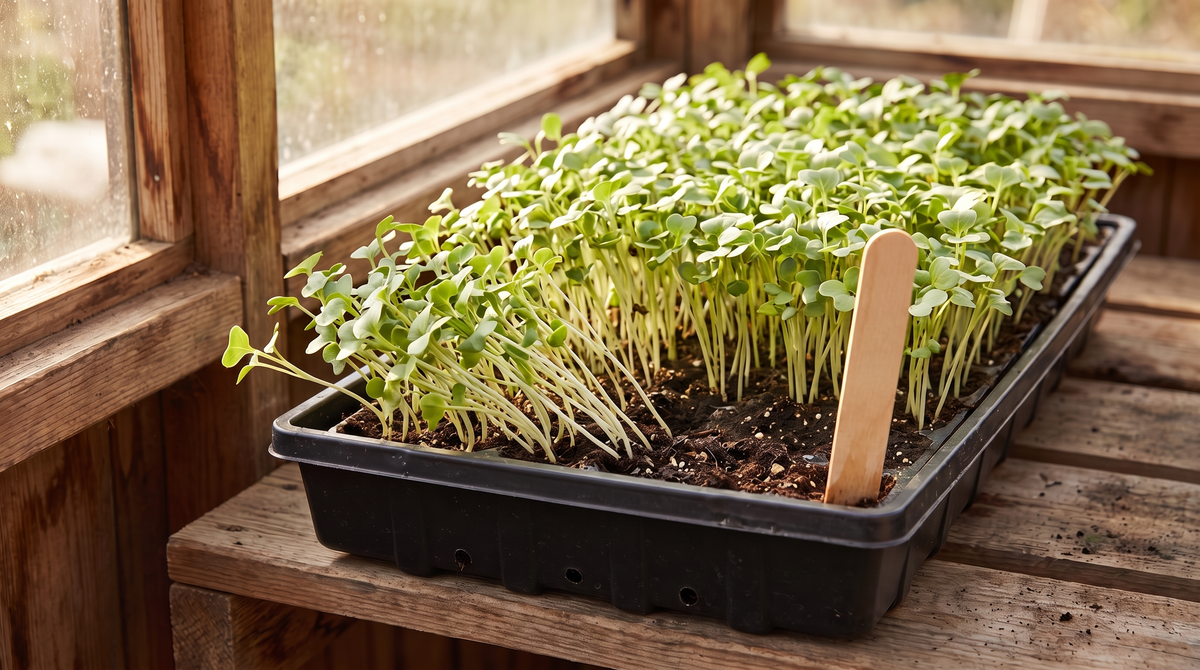
When microgreens fall over, don't start changing everything at once. First, look at the pattern. A tray leaning toward one side gives you a different clue than a patch of seedlings collapsing at the soil line.
Falling over doesn't identify the cause by itself. It doesn't automatically mean damping-off, and one quick adjustment won't explain every tray. A short checklist can help you decide what to inspect next.
Start With the Pattern and the Stems
Step back and look across the whole stand. Is it leaning in one direction? Are the stems long but still green and intact? Is the tray flat in a fairly even way, or are seedlings failing in scattered patches?
One-sided leaning puts light direction near the top of the list. Penn State Extension notes that shoots may lean toward light when light is limited. Controlled research also found that light intensity affected stem length in cabbage and Chinese kale microgreens. Still, light responses differ by crop and treatment, so compare the tray with the same crop at the same stage when you can. See Penn State's microgreen growing guide, the cabbage and Chinese kale light study, and research on three Brassica species.
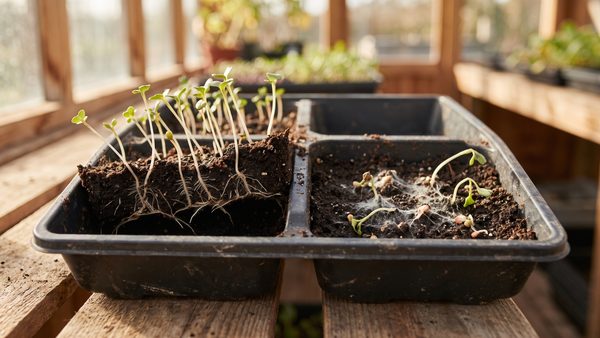
Next, inspect the stems at the soil line. Green, intact stems that bend or lie down aren't the same as tissue that's breaking down. University of Minnesota Extension lists damping-off signs such as failed emergence, water-soaked or thread-like constrictions, gray-to-brown tissue, mushy or rotting stems, wilt, damaged roots, and sometimes fluffy white growth in high humidity.
Those signs raise disease concern. Posture alone doesn't. Cool, wet conditions, low light, overwatering, and slow seedling growth can increase damping-off risk, but a risk factor isn't proof that disease is present. If you see tissue breakdown or root damage, isolate the suspect tray and review moisture and sanitation conditions instead of propping up rotted seedlings.
Check Water, Drainage, and Density
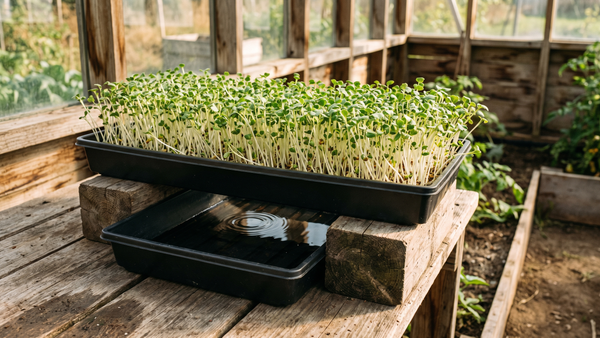
Look for standing water, blocked drainage holes, or medium that stays saturated. Check whether the tray sits level and drains evenly. Wet foliage and slow drying are useful observations too. Penn State recommends drainage holes, avoiding over-irrigation, and letting excess water drain. Its guide also describes bottom watering as a way to wet the medium while limiting direct water contact with the greens. Read the watering and drainage guidance.
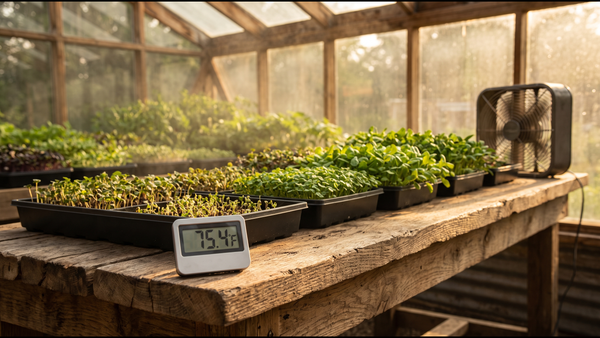
Air circulation belongs in this moisture check. It can help manage lingering moisture and stagnant humidity. Think of it as one part of drying management, especially when the canopy stays wet or humid.
Then check density. Microgreens are sown thickly, but the right seeding rate depends on the crop and growing system. Penn State says rates vary with germination, seed size, soil and air temperatures, and light. Research on kohlrabi, mustard, and radish also found species-dependent density tradeoffs. That makes crowding something to inspect, not proof of the cause or disease. Compare tight patches with successful trays of the same crop and stage. See Penn State's production overview and the three-species density study.
Inspect the Tray, Medium, and Crop
Check whether the tray is warped or tilted. Look for shifted medium, bare patches, uneven compaction, weak seed-to-medium contact, or roots that haven't established evenly. Moist medium helps small seeds adhere during germination, and working drainage gives excess water somewhere to go, according to Penn State Extension.
Large-seeded crops deserve one later check. For pea and sunflower, weight during germination can help maintain seed-to-soil contact. It can also help with hull release in sunflower and some other crops. Retained hulls or a heavy-looking cotyledon canopy may make those stands appear top-heavy, but treat that as a secondary, crop-specific clue. This guidance applies during germination, not as a later rescue step.
Write down the crop, seed lot, sowing date, symptom location, recent setup changes, watering pattern, drainage condition, and density. That record gives you something useful to compare with the next tray.
Final Thoughts from Wilshires Organics
A fallen stand is a starting point, not a diagnosis. Check the pattern, stem tissue, roots, light, moisture, drainage, density, tray, medium, and crop in that order. Several conditions can overlap.
The goal isn't instant certainty. It's to separate simple leaning from tissue breakdown and narrow the next check without making the tray worse through a string of rushed changes.
Want fresh-cut microgreens this week? We harvest to order in Ocala and have them ready for pickup. See what's available and reserve your tray.