Kids Won't Eat Greens? Microgreens Might Be the Easier On-Ramp
Kids won't eat greens? Microgreens are nutrient-dense, easy to grow, and research on repeated exposure shows how to help kids accept them.

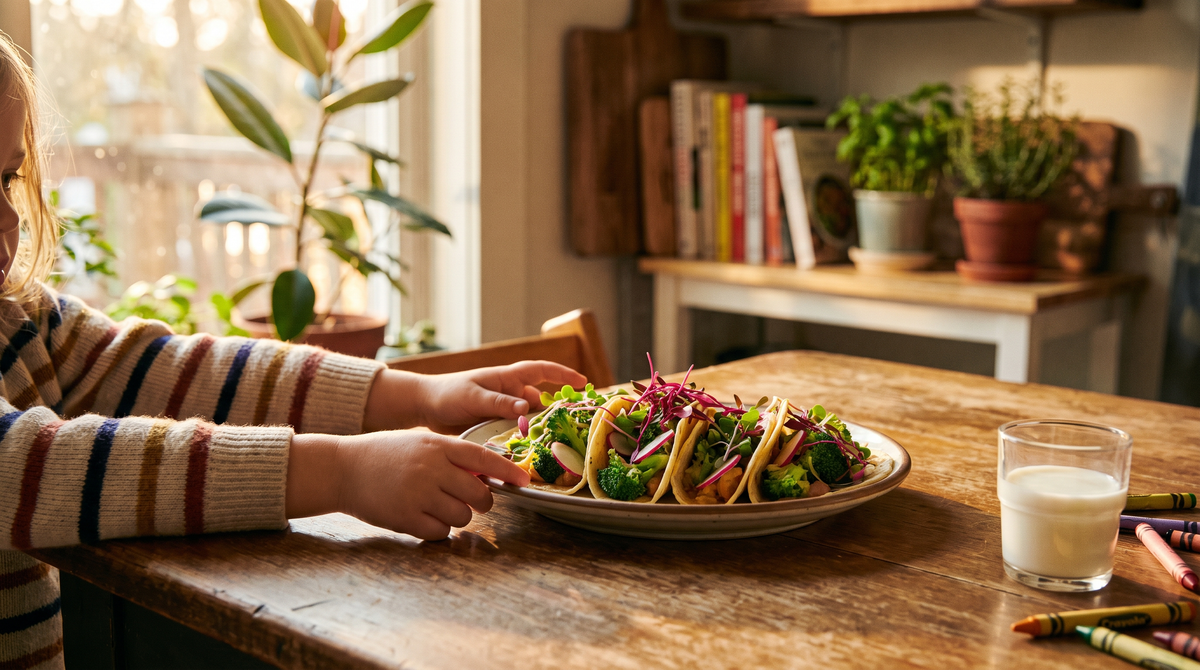
We hear it at the farm stand almost every Saturday. A parent picks up a tray, turns to their kid, and gets a look that says "not a chance." The kid eats crackers in the car. The greens go home and sit in the fridge.
That gap between what we grow and what kids eat is real. Microgreens sit in an interesting spot. They're small, tender, and they don't carry the bitter punch mature greens can hit a kid with. But here's the honest part: nobody has studied microgreens specifically in children. A PubMed search for "microgreens children nutrition" returns zero results. What we can say comes from general produce research, and we need to be straight about that.
What the Nutrition Research Actually Shows
The foundational study on microgreens nutrition came from Xiao et al. in 2012. They analyzed 25 commercially available microgreens and found that microgreen cotyledon leaves had higher nutritional density than mature leaves of the same species, compared against the USDA National Nutrient Database. Vitamin C ranged from 20.4 to 147.0 mg per 100 grams fresh weight. Red cabbage, cilantro, garnet amaranth, and green daikon radish had the highest concentrations of specific nutrients.
That's solid research. But it was done on produce, not on kids. We can reasonably say microgreens are a nutrient-dense choice for the whole family, the same way any leafy green is. What we can't say is that microgreens are "packed with nutrients kids need." No pediatric studies back that. The nutrients include compounds studied by researchers for their health-supporting properties. That's as far as the evidence goes.
The Sprouts Question: What FDA Says and What It Doesn't
The FDA explicitly warns vulnerable populations, including children, to avoid raw sprouts of any kind. The reason: sprouts grow in warm, dark, humid conditions that favor Salmonella, Listeria, and E. coli. Bacteria on the seed can multiply to dangerous levels during sprouting, even under sanitary conditions.
Microgreens are not sprouts. They grow with light and air circulation, a different risk profile. The FDA's sprout warning doesn't automatically extend to microgreens. But the FDA hasn't issued microgreens-specific guidance either. A 2024 study showed pathogens can transfer from contaminated seeds or substrate to microgreens. They're not risk-free.
If you're serving microgreens to kids, same rules as any produce. Wash under running water. No soap, no detergent. Store at 40°F or below. That's FDA general produce storage guidance, not microgreens-specific. Buy from a trusted grower. If you wouldn't eat it raw yourself, don't give it to your kid.
Repeated Exposure: The Strongest Evidence We Have
Here's where the research gets genuinely useful. Multiple RCTs show that repeated taste exposure increases children's acceptance of new vegetables. The best-evidenced part of the whole topic.
Wardle et al. (2003) gave 49 children ages 5 to 7 eight daily tastes of sweet red pepper. Liking and consumption both increased significantly. Remington et al. (2012) worked with 173 children ages 3 to 4, 12 daily tastes with a sticker reward. Intake and liking increased, and the effect held at 3 months. Fildes et al. (2014) scaled this to 442 children with 14 daily tastes at home, no professional contact required. Bouhlal et al. (2014) found repeated exposure effective for increasing vegetable acceptance in toddlers.
The pattern: offer a new vegetable 8 to 14 times. Nobody has tested this with microgreens specifically. But the principle is robust across ages 3 to 7, across multiple vegetables, across home and school settings. Offering microgreens repeatedly, on a pizza or in a sandwich, could follow the same pattern. That's a reasonable bet, not a tested finding.
Choking and Growing: The Questions Parents Ask
Leafy greens don't show up in the top choking foods. Chapin et al. (2013) analyzed nonfatal food-related choking in US children ages 0 to 14. The top foods were hard candy, other candy, meat, and bone. No specific guidance exists on when to introduce microgreens to infants or toddlers. The texture, small and tender leaves, doesn't match common high-risk choking foods, but no study has evaluated that directly. The AAP recommends starting solid foods around 6 months. Talk to your pediatrician before introducing microgreens to a young child.
On growing: a 2025 controlled trial in Jordan worked with 216 students ages 10 to 12 over five months. A school garden and nutrition education program improved vegetable intake, improved BMI, and increased nutrition knowledge. A pilot study called "Cook-Grow!" showed garden-based education can adapt to special populations, specifically childhood cancer survivors. That's a pilot, not a broad finding. No study has tested growing microgreens specifically as a children's activity. But they're fast, they don't need a backyard, and they harvest in days. That's a practical starting point even if the research hasn't caught up.
Final Thoughts from Wilshires Organics
We're not going to tell you microgreens will fix picky eating. Nothing in the research says they will. What the research does say: repeated exposure works, microgreens are nutrient-dense compared to mature greens, and the FDA's sprout warning doesn't extend to microgreens but doesn't clear them either. The gaps are real. No pediatric studies exist. No microgreens-specific safety guidance exists.
What we can offer is a fresh, carefully grown product and what we've learned from growing it. Our snacking green is one we've heard kids will eat. That's a customer anecdote, not a research claim. If you want to try microgreens with your family, wash them, store them cold, and offer them more than once. Stop by the farm stand Saturdays or check the harvest days order page if you want to pick some up.
Want fresh-cut microgreens this week? We harvest to order in Ocala and have them ready for pickup. See what's available and reserve your tray.