Microgreens Leaning After Blackout? How to Set the Light Without Guessing
Microgreens leaning after blackout? Learn how PPFD, lamp hours, DLI, spectrum, and crop response can guide a practical lighting setup.

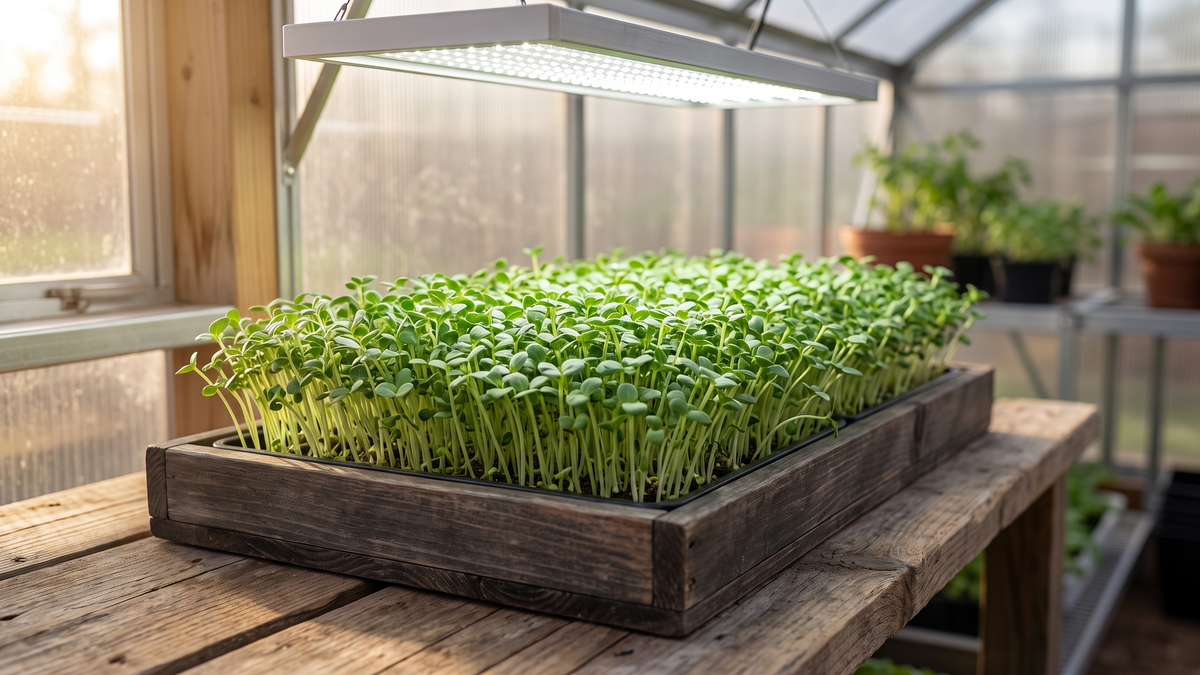
A microgreen tray can look ready to uncover, but that doesn't answer the next question: how much light should it get? Copying a lamp schedule from another grower sounds easy. The trouble is that crop, fixture output, shelf setup, and growing stage can all change what reaches the plants.
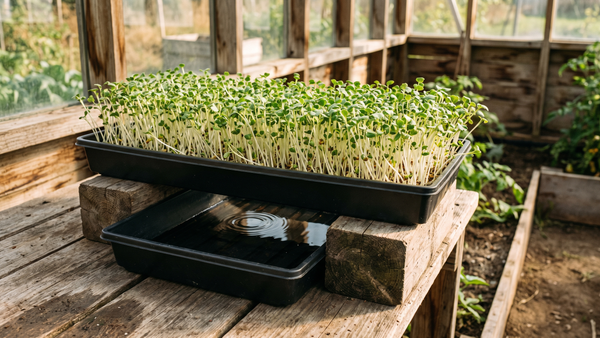
Blackout is the covered or dark part of germination. It doesn't automatically mean every crop must be stacked or weighted. Those are related practices that may serve particular purposes with particular crops. Penn State Extension's microgreen guide recommends darkness for a few days, then describes moving seedlings into light after germination is complete and they've reached enough height. That's a developmental checkpoint, not one date that fits every tray.
Once the cover comes off, microgreens need light to green up and develop a compact, even canopy. But one setting shouldn't be treated as a universal answer for every crop. A useful starting point is to understand what the lamp is delivering, keep the setup repeatable, and let the crop's response guide careful adjustments. The goal isn't to find one magic number. It's to create a setup you can measure, repeat, and adjust without changing everything at once.
Four Parts of the Post-Blackout Light Setup
Light after blackout has two jobs. It supplies energy for photosynthesis, and it acts as a signal that affects seedling form and development. A peer-reviewed review of indoor LED lighting explains that plants respond to intensity, spectrum, direction, and photoperiod. That helps explain why lamp hours alone don't tell the whole story.
Four terms make lighting easier to understand:
- PPFD is the light intensity reaching the crop at that moment.
- Photoperiod is the number of hours the light stays on.
- DLI is the total photosynthetic light delivered across the day.
- Spectrum is the mix of light wavelengths reaching the plants.
PPFD and photoperiod work together to determine DLI, as explained in this controlled microgreen lighting study. Two trays can get the same number of lamp hours but receive different daily totals if one fixture delivers more light at canopy level. Wattage and fixture distance don't settle the question by themselves either. Output, coverage, canopy height, heat, and duration all affect the practical result.
Crop response varies too. In one controlled study of cabbage and Chinese kale microgreens, researchers tested 30, 50, 70, or 90 µmol·m⁻²·s⁻¹ PPFD for 12 hours per day under a red/blue/green LED system. The named cultivars were sampled eight days after sowing, with three replicates per treatment. Hypocotyls shortened as intensity increased, while fresh and dry weights didn't follow one simple pattern. That's a study example, not a lighting recipe. It shows why crop and outcome need to stay attached to any number.
Build a Baseline, Then Change One Thing
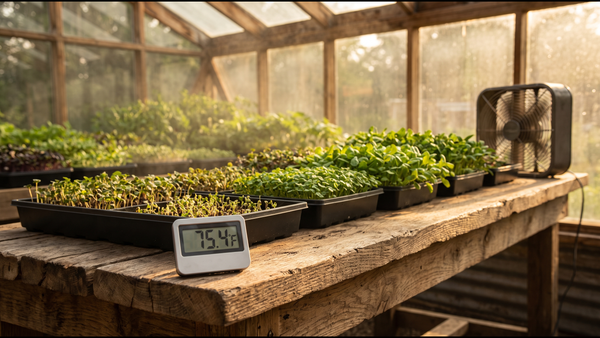
Start by making the setup measurable and repeatable. Record the crop and cultivar, when blackout ended, the PPFD at canopy level if you can measure it, lamp hours, harvest day, and the tray result. Then change one lighting factor at a time. This won't create an instant perfect setting, but it can make each adjustment easier to interpret.
Coverage matters as much as the center reading. Penn State notes that shoots may lean when light is limited. If a canopy leans toward the source or develops unevenly, check fixture coverage, tray position, and light at canopy height before changing several things at once.
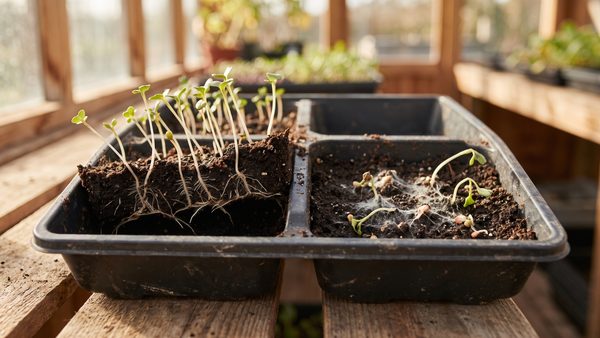
Other signs need a wider check. Long or pale growth may be a reason to inspect the lighting setup, but it isn't proof that light is the only cause. Curling, discoloration, or leaf damage should prompt a look at intensity and lamp hours along with fixture heat, irrigation, airflow, humidity, and nutrition. Keep the diagnosis conditional. Changing three variables together can hide the real cause.
More daily light can support growth up to crop-dependent limits, but excessive intensity or an unsuitable photoperiod can become detrimental. Controlled research also shows that species and cultivars don't respond alike. That makes small, recorded adjustments more useful than chasing the highest number or longest schedule.
Final Thoughts from Wilshires Organics
After blackout, microgreens need light that reaches the canopy evenly and supports compact development. The useful amount depends on intensity, duration, spectrum, crop, and growing conditions. That's why a copied schedule or lamp distance can be a shaky starting point.
Move trays into light when germination and seedling development show they're ready. Measure at canopy level when possible. Record the setup, watch for leaning or uneven coverage, and adjust one factor at a time. A repeatable baseline won't remove every variable, but it'll give you a clearer way to learn what each crop needs.
Want fresh-cut microgreens this week? We harvest to order in Ocala and have them ready for pickup. See what's available and reserve your tray.