Are Microgreens Actually More Nutritious Than Mature Vegetables? Here's What the Research Says
Are microgreens really more nutritious than full-grown vegetables? Here's what USDA research and peer-reviewed studies actually show about vitamins, minerals, and what matters most.

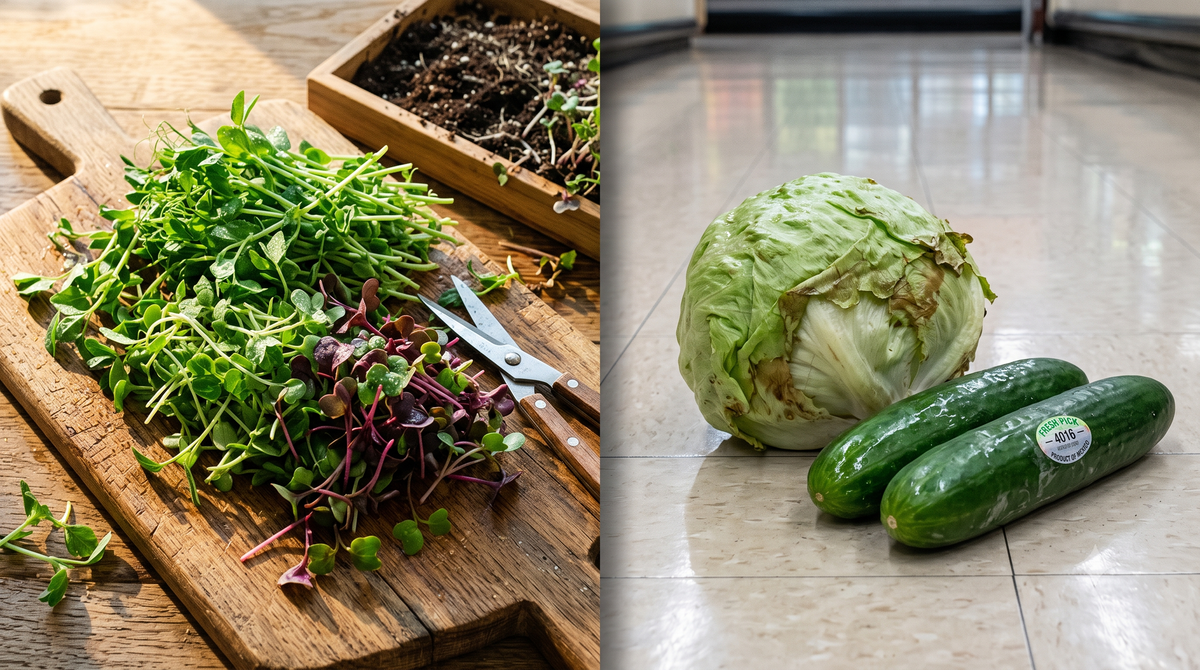
We've all seen the headlines. Microgreens have "40 times the nutrients" of full-grown vegetables. A tiny pinch of radish greens supposedly packs more punch than an entire head of broccoli.
It sounds too good to be true. And in some ways, it is. The real story is more interesting than the soundbite, and it's worth knowing if you're spending money on these greens or just curious what that little garnish actually does for you.
The Vitamin Advantage Is Real
The best research we have comes from a 2012 USDA and University of Maryland study that analyzed 25 commercial microgreen varieties. The results weren't subtle. Red cabbage microgreens tested highest for vitamin C. Cilantro topped the charts for carotenoids. Green daikon radish led for vitamin E. A 2018 USDA review confirmed the pattern: "In general, microgreens contain greater amounts of nutrients and health-promoting micronutrients than their mature counterparts."
For vitamins C, E, and K₁, for polyphenols, and for the sulfur compounds in brassicas (think broccoli and radish), microgreens consistently outperform. A 2025 review in the International Journal of Food Science confirmed that Brassicaceae microgreens contain significantly more glucosinolates than the full-grown plants, and their composition often differs too.
This is where the "up to 40×" figure comes from. It's real, but it applies to specific vitamins (especially vitamin E and C) in specific varieties compared to USDA database values for mature vegetables. It's not a blanket statement about every nutrient in every microgreen.
The USDA researchers also noted that because microgreens are so concentrated, smaller amounts may provide similar nutritional effects compared to larger quantities of mature vegetables. That's the core practical takeaway. You don't need a salad bowl full of microgreens to get something meaningful.
Where Mature Vegetables Come Out Ahead
This is where the story gets balanced. Not everything tilts toward microgreens.
A 2022 study from Punjab Agricultural University compared 20 celery genotypes side by side, microgreen stage versus mature leaves. Microgreens won for nitrogen, phosphorus, calcium, sodium, and sulfur. But mature celery leaves were higher in potassium, zinc, copper, and manganese. Iron showed no significant difference.
A 2020 University of Naples study on lettuce found calcium and magnesium were higher in microgreens. Polyphenols were denser too, especially in red lettuce. But mature lettuce leaves had more carotenoids, the compounds that give vegetables their color and that researchers study for health-supporting properties. The authors concluded that when carotenoid content is the goal, mature lettuce leaves should be the prime culinary choice.
The pattern is clear. For vitamins and antioxidants, microgreens usually lead. For minerals, it depends on which mineral and which plant. Anyone who tells you microgreens are "more nutritious in every way" hasn't read past the headlines.
What Matters More Than Harvest Time
If you take one thing from the research, it should be this: what you grow matters as much or more than when you harvest it.
A 2021 study in Foods found that genotype is "the principal source of variation for all constituents" in brassica microgreens. The response of mineral and phytochemical composition to growth stage was limited and largely genotype-dependent. In other words, a broccoli microgreen and a radish microgreen are not interchangeable. Their nutritional profiles differ dramatically.
There's also the question of what actually happens inside the body. A 2020 King's College London study found that mature fenugreek and rocket had higher total iron content than their microgreen versions. But iron uptake by intestinal cells was significantly higher from fenugreek microgreens. Total content on a lab report doesn't always predict what your body absorbs.
The most direct functional comparison comes from a 2016 USDA mouse study, the only side-by-side functional comparison available. Mice fed a high-fat diet with red cabbage microgreens showed lower circulating LDL, reduced liver cholesterol, and less inflammatory cytokine expression than those fed mature red cabbage. Preliminary research suggests microgreens may offer benefits beyond what nutrient tables alone capture, but human clinical trials haven't been done yet.
Final Thoughts from Wilshires Organics
Microgreens aren't a magic bullet and they're not a scam. They're a specific tool in a larger nutrition picture. The evidence says they're especially dense in vitamins C, E, and K₁, polyphenols, and glucosinolates. For minerals like potassium and zinc, mature vegetables often have the edge.
The smartest approach is probably the simplest one. Eat both. Microgreens give you concentrated vitamins and antioxidants in small amounts. Full-grown vegetables give you fiber, volume, and a different mineral profile. Neither replaces the other, and neither needs to.
If you're buying microgreens, ask what variety you're getting. Red cabbage, broccoli, and radish have the strongest research behind them. And eat them fresh. Studies show shelf life doesn't exceed ten days at proper refrigeration.
Want fresh-cut microgreens this week? We harvest to order in Ocala and have them ready for pickup. See what's available and reserve your tray.