Stop Guessing About Blackout: A Crop-Specific Guide to Covering and Weighting Microgreen Trays
Learn when microgreen trays may need covers or weight, what each tool does, and which crop-specific cues can guide the move to light.

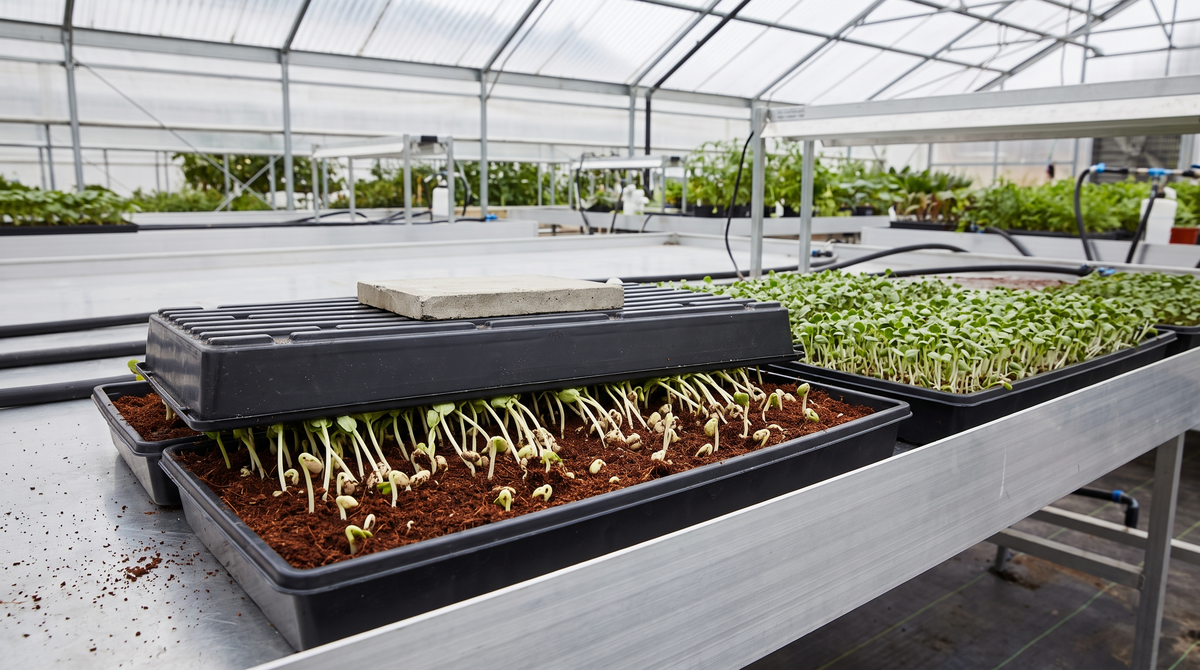
The first few days of a microgreen tray can get confusing fast. Should the seed be covered? Does the crop need darkness? Should a second tray sit on top? When does the weight come off, and when does the tray move to light?
There isn't one answer for every crop. A cover, blackout dome, or weighted tray is a tool for a particular job. The right setup depends on the species and what you can see happening in the tray. That's a better starting point than copying one number of days or one tray weight across everything you grow.
Start With the Job the Cover Needs to Do
A cover can help manage moisture during germination. Penn State Extension's step-by-step guide says a light-blocking tray cover can help keep newly sown seed moist while providing a dark germination environment. But darkness isn't automatically the goal for every crop.
Virginia Cooperative Extension's microgreens guide separates a humidity dome or plastic cover from an opaque blackout cover. It also tells growers to check the needs of the species. That distinction matters. A clear cover used to hold humidity and an opaque cover used for dark germination aren't doing exactly the same job.
Blackout isn't the only approach to early moisture, either. Penn State's Growing Microgreens guide describes placing a thin layer of soilless medium or vermiculite over broadcast seed to support uniform moisture around it. The practical point is simple: choose a method for the crop and the purpose. Don't turn the method into a rule for every tray.
Use Weight for a Supported, Crop-Specific Purpose
Weighted covering has a narrower purpose than some growing advice makes it sound. Penn State recommends weight for some species, including pea and sunflower, to maintain seed-to-medium contact during germination. For sunflower and certain other crops, pressure over emerging shoots may also help release seed hulls from the cotyledons.
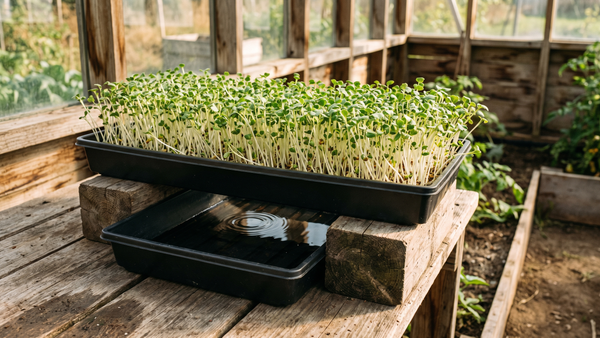
Utah State University Extension's growing guide describes a top tray with added weight to keep seed in contact with the medium while roots enter it. Its crop table uses different covered periods for different species. That variation is another reason not to borrow one timing rule for every crop.
The reviewed guidance supports weight for seed contact, root entry, and crop-specific hull release. It doesn't give us a universal tray weight. It also doesn't establish one load as a proven way to improve germination percentage, root strength, or yield across all microgreens.
More pressure isn't a useful goal by itself. Excess weight could deform or trap emerging shoots, but the reviewed sources don't provide a measured injury threshold. Use only a crop-specific method supported by reliable guidance instead of adding an arbitrary heavy load.
Separate Pressure Removal From the Move to Light
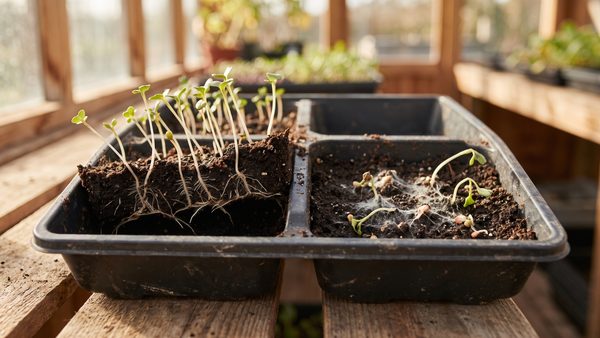
Removing direct pressure and moving a tray into light aren't always the same decision. In Utah State's example, the contacting top tray comes off when roots are visibly pushing into the medium. An inverted tray may then remain as a non-contacting cover during the rest of that crop's dark phase. That's one extension example, not a required sequence for every species.
Other extension guides use different visible cues. Virginia Tech says trays can be uncovered when most seedlings have germinated. Penn State points to completed germination and sufficient seedling height. Colorado State University Extension recommends daily checks and a move to light once good germination is visible across most of the tray.
A practical tray check can include:
- Are roots entering the medium?
- Is emergence broad and reasonably even?
- Is the medium moist without obvious excess?
- Is the tray lifting, and what do the crop's other cues show?
- Is there condensation, stagnant air, or visible crop disease that needs attention?
This is an observation list, not a validated formula. Tray lift, condensation, and the other risk checks aren't stand-alone signals that apply the same way to every crop.
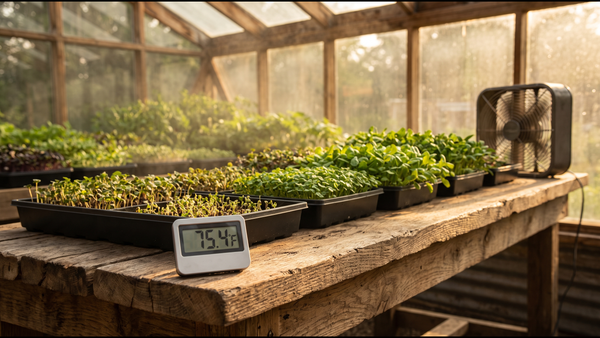
Moisture and airflow deserve attention throughout this stage. Penn State advises watering only as needed, allowing drainage, avoiding excess moisture, and improving air circulation when needed. Virginia Tech also connects humidity and airflow management with reduced crop disease pressure in the moist conditions microgreens require.
Final Thoughts from Wilshires Organics
Our practical reading of the extension guidance is to treat covers and weights as short-term, crop-specific tools. Start with the species. Know whether you're managing moisture, providing darkness, maintaining seed contact, or helping hulls release. Then watch the tray for the transition cues that match that crop and method.
Use the crop requirements and visible tray progress to make the decision. That keeps the method tied to what the cover or weight needs to do, without turning one grower's routine into a rule for every tray.
Want fresh-cut microgreens this week? We harvest to order in Ocala and have them ready for pickup. See what's available and reserve your tray.