Stop Guessing at Microgreen Seeding Rates: A Practical Way to Find the Right Density
Stop guessing at microgreen seeding rates. Measure tray area, check germination, and run side-by-side trials to find a marketable stand.

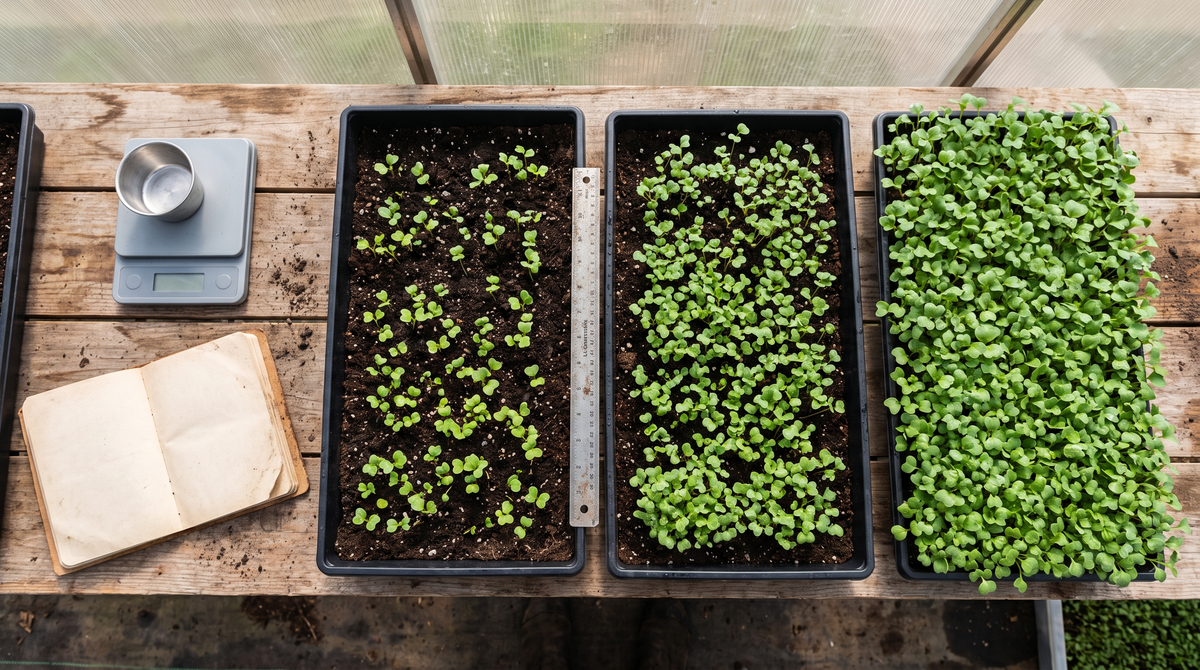
A seeding rate can look exact on paper and still give the wrong result in a tray. “Grams per tray” leaves out the crop, the seed lot, the growing area, germination, and the kind of stand you’re trying to produce.
There isn’t one well-supported rate for all microgreens. Seed size and weight differ by crop. Germination changes from one lot or set of conditions to another. Tray geometry, medium, watering, airflow, environment, harvest age, and the chosen quality endpoint can change the result too.
Published numbers and credible crop-specific guidance can help set a starting bracket. They can’t replace calibration in the area and system being used. The goal is an even, acceptable crop stand, not a tray that merely received the stated number of grams.
Start with the surface the seed can actually occupy. Measure the inside length and width of a rectangular tray. If edges, channels, or other features reduce the usable surface, exclude them from the measured seedable area. This is an operational recommendation based on Penn State Extension’s area-based guidance, not a universal protocol.
Record seed weight against that area. Grams per measured area creates a baseline that can be compared between test trays and production trays. A cup or spoon may be convenient later, but calibrate it by weight for the crop and current lot. Penn State recommends weighing seed to establish a tray amount. University of Maryland Extension shows why volume or weight doesn’t represent the same number of seeds across different crops.
Measure the Seedable Area Before Comparing Rates
Spread the measured amount evenly and avoid obvious piles. Don’t force every crop into a rule such as “seeds must touch but never overlap.” Appropriate spacing depends on seed size, crop, and growing system.
Area scaling can help build a trial, but the math isn’t a biological guarantee. The practical formula is:
test seed weight = known seed weight × (test seedable area ÷ known seedable area)
Any result is a hypothetical starting point. Recheck it in the larger tray because watering uniformity, edges, and air movement may not scale in the same way.
Seed weight tells only part of the story. A tray sown with the same weight can produce a different stand when germination or emergence changes.
Penn State Extension describes a simple viability check using seed in a moist paper towel, followed by a count of how many seeds germinate. Water, oxygen, temperature, and sometimes light affect germination. Conditions in a tray can differ from a paper-towel test, so record actual emergence too when possible.
Avoid automatically adding enough seed to replace every seed that didn’t germinate. Germination percentages can support an emergence-target calculation, but extra seed also changes the amount of seed mass, hulls, respiration, and moisture demand in the tray. Treat the calculation as a reason to run another test, not as a full-scale instruction.
Check Germination and Actual Emergence
A useful comparison can track both grams per measured area and emerged seedlings per area. Retest when a seed lot or cultivar changes, germination shifts, tray geometry or medium changes, or the environment and harvest endpoint change. Direct comparisons among multiple commercial lots of the same cultivar were thin in the reviewed source set, so this source review doesn’t establish a general size for lot-to-lot effects.
More seed may increase total fresh yield up to a point. Research also shows that the response can level off or decline, and individual-shoot weight or marketable quality can change as crowding increases. A lower rate has its own trade-off and can reduce output per area. There’s no universal line where a tray becomes under-seeded.
Density also works alongside moisture and air movement. In one 2026 controlled study of cress, rocket, and pea, measured microbial loads generally increased with density in that experimental system. Those counts were study outcomes, not declarations that a tray was safe or unsafe. Other research associated excessive stands with hindered air circulation and conditions more favorable to fungal growth. That doesn’t mean density alone causes mold, and airflow doesn’t guarantee disease prevention.
Run small side-by-side trials at lower, middle, and higher starting rates. Keep the medium, watering, temperature, blackout or stacking, light, and harvest day as constant as practical. Suggested observations include emergence, uniformity, bare patches, lodging, elongation, visible mold, root-zone moisture, harvest difficulty, total fresh weight, marketable weight, and seed cost. These are useful trial fields, not a list of universally validated endpoints or a statement of existing Wilshires practice.
Final Thoughts from Wilshires Organics
A printed rate is a starting bracket. The rate still needs validation for the crop, seed lot or cultivar, measured area, growing system, environment, and chosen endpoint.
The best practical choice may be the lowest tested rate that consistently produces the desired marketable stand and yield without unacceptable crowding, moisture retention, harvest difficulty, disease pressure, or seed waste. That’s an operating recommendation, not a published law. Measure the area, weigh the seed, check emergence, and compare trays side by side. A short trial gives you better information than a universal number ever could.
Sources: Penn State Extension: A Step-by-Step Guide for Growing Microgreens at Home, Penn State Extension: Seed and Seedling Biology, University of Maryland Extension: Growing Microgreens and Baby Greens Indoors, Toscano et al. 2024, Ghoora et al. 2022, and Kyriacou et al. 2026.
Want fresh-cut microgreens this week? We harvest to order in Ocala and have them ready for pickup. See what's available and reserve your tray.